Showing posts with label art. Show all posts

Monday, 23 February 2015

New Arts Centre at University of Bath

When I joined the University of Bath as an undergraduate in 2007, the demands for a new arts centre had already been bubbling away for some time. Over my four years there, reporting on the arts for the student radio station, and later attending regular student representative meetings, the fabled arts centre - supposedly 'in progress' - began to feel increasingly utopic. So it was with delight that on my most recent visit to Bath this Tuesday I visited The Edge, which houses not only a theatre and rehearsal space, but arts studios, music practice rooms and a dance studio. The most pleasant surprise for me, though, were the three galleries run by the ICIA (Institute of Contemporary Interdisciplinary Arts), ensuring that free contemporary art would be a permanent feature of the new student experience.


Passage - Miranda Whall

A perfect fit for the inaugural exhibition at the ICIA, interdisciplinary artist Miranda Whall has created a multi-screen and surround-sound installation, charting her physical passage through Europe, Mexico and Thailand and the simultaneous artistic passage through her recent projects developed in each place. A Turkish dancer twirls from screen to screen, later a solitary goldfish swims the same path. Vibrant flashes of fruit flying through the jungle and smashing against a tree juxtapose the stillness of an old woman at rest. Singing in French and Spanish, bird calls, music, and muddled underwater whispers combine with the images to create an immersive and hypnotic experience.

http://www.mirandawhall.com/projects/passage/


0º00 Navigation (Part II) - Simon Faithfull


Equally interdisciplinary artist Simon Faithfull brings together a video, a slide show, a globe, and a range of postcards reproducing line drawings and diary extracts, to represent his 'obsessive and deranged journey exactly along the Greenwich Meridian'. Part I charted his journey through England, while in this second part, we travel from the top of France to the bottom of Africa. The slide show is particularly striking: rapidly progressing from verdant French countryside to barren Burkina Faso, with the coordinates at which each photograph was taken in the bottom left corner, it forces the viewer to confront the common usage of 'West'. The written extracts, meanwhile, predominantly from the African leg of the journey, give fascinating glimpses of a part of the world rarely present in travel literature.


Find out more about the new centre and what's on at www.icia.org.uk

Tuesday, 17 June 2014

King’s Cultural Institute: Academia, Art and Engagement

(Originally posted 10 May 2013)
The last few weeks have been very busy but very exciting for me. In between writing 11,000 words for my upgrade, I’ve been lucky enough to have been working part time for King’s Cultural Institute. As a passionate believer in the need to bring together academia and the cultural sectors to reach wider audiences, I am really inspired by the work of KCI and their innovation in public engagement.
By first involvement with KCI was as a gallery assistant at the Integrating Knowledge exhibition at Inigo Rooms  The project paired King’s academics and PhD students with MA Communication Design students from Central St Martin’s to create art installations and videos that share academic research in a way that entices the public. Working at the gallery was an amazing opportunity to meet the artists and learn about their work, as well as seeing first hand how visitors appreciated both the artistic and the educational qualities of the works. (See my full blog about the event here).
Then, as of last Friday, I am working on the Arts and the Digital Creative Lab project, taking notes and writing reports. The project is a collaboration between KCI and digital creative agency Caper, which brings together about 50 participants, including academics from across the nine schools and representatives of the cultural sector, from museum curators to theatre company directors.  The first session on 3 May gave participants the chance to discuss their work, find shared challenges and consider opportunities for collaboration. In the next stage, on 23 May, the participants will try to find ways to solve the problems they identified, in the form of collaborative projects, which they can then bid for £2500 of funding for. The winning projects will then be presented on 3 July. I can’t wait to see where all the ideas identified last week lead!

Tuesday, 31 December 2013

Paris: Joseph Arthur @ Galerie Chappe and Peter Gabriel @ Bercy

For three years since I left Paris, I've been waiting for an excuse to go back, so when Joseph Arthur suggested I should come to his gallery opening, in one of my more impulsive moments, I booked an overnight bus for the next evening and spent one incredible day in one of my favourite cities.


I arrived at 8am and began with something of a nostalgia tour, heading straight for St Eustache, a church that I always preferred to its more glamorous cousin Notre Dame. I then strolled through Ile de la Cité to my "fancy apartment on the Boulevard Saint Michel" (more like a nunnery in reality) and greatly confused the receptionist with my strange desire to wander around and reminisce. I got similarly nostalgic in les Jardins du Luxembourg, which I visited every day while I lived there, whether rushing through on my way to class, catching up on some work among the flowers or just people-watching.


Then in the evening I headed up into Montmartre to Galerie Chappe, "Paris' highest gallery", specialising in art related to music and film. While I'd seen many of Joe's paintings spread around Heath Street Baptist Church, it was amazing to be in a gallery packed full of them, ranging from intricate, detailed pieces to huge murals, all with Joe's signature figures. One of my favourites was a painting on the back of a door that Joe had found on the street and taken back to his hotel room. As well as enjoying the art, I got to chat to lots of interesting music people, including Joe himself, his band - Bill Dobrow and Rene Lopez - and Grammy-award winning singer-songwriter Jesse Harris.


Joe performing Saint of Impossible Causes surrounded by his paintings:


I was incredibly lucky to be in the right place at the right time, because that night Joe's good friend and mentor Peter Gabriel was in town, playing the 17,000 seater stadium in Bercy, and I got to go along with Joe, Bill and other friends for free. While not a huge Gabriel fan by any means (I know Solsbury Hill obviously, and In Your Eyes from seminal 80s smush-fest Say Anything) but wow, the man knows how to put on a show! Gabriel bounded with incredible energy throughout, aided by Manu Katché on drums and a spectacular light show. I was completely swept up in the joy of it all and the enthusiasm of the enormous crowd of fans.


All in all it was an unforgettable evening, made even more special by the fact that it was totally unexpected. I should take spontaneous trips more often!

Tuesday, 5 November 2013

Paper @ Saatchi Gallery

When my housemate was looking for a free exhibition to document for a university project, I couldn't think of anywhere better than the Saatchi Gallery, on the King's Road. In my opinion, it's the best place in London for contemporary art exhibitions, and it's always free. 

We were lucky to catch the Paper exhibition days before it closed, having already been extended due to popular demand. As quite a vague theme, 'Paper' gave space to everything from pencil sketches and collages to enormous paper sculptures. Although some sketches didn't really seem worthy of inclusion in the exhibition, there were some really beautiful, or just incredibly cool, pieces. Here are some of my favourites (photos stolen from Matej Oreskovic):

José Lerma (1971, Seville, Spain) and Héctor Madera (Puerto Rico) - Bust of Emanuel Augustus (2012)
The artists, both resident in New York, were fascinated by the story of this grandly named journeyman boxer and decided to make a sculpture equal to the size of his personality.


Steven Lowery (1980, Newcastle) - Selected Works (2003)


Dominic McGill (1963, Brighton) - Muqaddimah (2009-2010)

I nearly had to be dragged away from this enormous mural as I would happily have spent a whole day reading the densely scrawled quotes - ranging from The Bible to Das Kapital - that make up this epic dystopian vision of contemporary society.


Marcelo Jácome (1960, Rio de Janeiro) - Planos-Pipas (Kite Planes, 2013)

We were struck by the scale and beauty of this installation, made of bamboo and tissue paper, which seems to float through the gallery.


Han Feng (1972, Harbin, China) - Floating City (2008)

I was totally hypnotised by the slowly rotating buildings that form this giant mobile, playfully subverting the idea of the city as something heavy and immovable. Each box had an individual photograph of a building printed on to it, which again made me want to spend hours comparing each one and guessing at the story behind them all. Who would live there? Would these very different houses ever come together in a real city?


Visit the exhibition yourself virtually through this video:


The Saatchi Gallery is open 7 days a week and all exhibitions are free. Find out more about the whole Paper exhibition and the artists involved here. The gallery will now close to change exhibitions and will reopen on 20 November with Body Language.

Saturday, 2 November 2013

Boogie Christ: Joseph Arthur @ Heath Street Baptist Church


Christ would wear cowboy boots, Christ would have sex, Christ would eat pizza and cut blackjack decks...

Regularly readers will know that I find it hard to write objectively about something I love, but this - far too overdue - account of Joseph Arthur's reverential gig at Heath Street Baptist Church in Hampstead on 11 October may be even more laden with superlatives than usual.

I've been a HUGE fan of Joe's since my dad, in his infinite musical wisdom, advised me to go to his gig at Café de la Danse in Paris four years ago. Joe blew me away then, playing for two hours solid and then some more acoustic at the merch stand passed curfew. Since then, the prolific Arthur has released three more solo albums, as well as albums with supergroups Fistful of Mercy and RNDM. His latest solo effort, the semi-autobiographical The Ballad of Boogie Christ, "about redemption and what happens after you find it and lose it", is considered by many to be his best yet, and certainly one of my favourite albums of the last few years, so it was with great excitement that I headed off to a Hampstead church for a sermon of a very unusual kind.

As well as an incredible musician, singer/song-writer and poet, Joe is also an artist, so we found the church adorned with his Basquiatesque creations. I loved the juxtaposition of his somewhat deranged visions with the sombre religious iconography. If I had a few thousand pounds to spare, I would have very happily taken one home with me.

Fellow New-Yorker Rene Lopez opened the show in style with songs from his new Latin-tinged Let's Be Strangers Again EP, ending with an old classic Roosevelt Is Burning. It was a real struggle for me not to jump out of my pew and start dancing, but it didn't seem appropriate in a church, so I had to limit myself to grinning like a crazy person.


Then it was time for the main attraction, with Joe accompanied by Rene on bass and Bill Dobrow on drums/rebolo. The packed set showcased the impressive range of styles that feature on The Ballad of Boogie Christ - rock, folk, soul, sung poetry... - as well as his trademark live guitar solos, which make spectacular use of a whole floor of effects peddles and loops. Scattered among the new tracks were classics including In the Sun, Chicago (one of my favourites, partly because of my weakness for the harmonica), and the hauntingly beautiful Redemption's Son. Joe struggled to speak through the gig - a mixture of insomnia and being weirded out by being able to see everyone as the church left the lights on - but that only made him even more endearing.


As well as his exceptional talent, one of my favourite things about Joe is how well he treats his fan. No amount of fatigue would stop him satisfying our demands for autographs and photos. It's this mixture that makes fans so devoted to him - my pew neighbour had travelled from Spain just for the gig - and is why, as we waited to meet our hero, all you could hear was fellow fans asking each other incredulously how he isn't playing a bigger venue... while  being selfishly grateful for the privilege of such an intimate gig. With the next album promising to be even better than Boogie Christ, I'm sure we won't have him to ourselves for much longer!

Visit josepharthur.com for more information, tour dates and live recordings of gigs. For a great introduction to The Ballad of Boogie Christ, watch the interview and live performance at KEXP below.


Monday, 22 April 2013

Integrating Knowledge - A King's Cultural Institute and Central St Martin's Collaboration

As a firm believer in the importance of public engagement for academia, I jumped at the chance to be involved in the Integrating Knowledge exhibition, even if only counting visitors and handing out information packs!

Integrating Knowledge is a collaboration between King's Cultural Institute and Central St Martin's to present research to the public in innovative and exciting ways. The project, curated by Caroline Sipos, paired students of MA Communication Design with academics and PhD students in Geography, Anatomy, English and Law to find ways to express academic research through videos, installations and interactive presentations. 

The exhibition covers topics as diverse as the Argentine Dirty War to neuroscience, while the theme of place/space runs through the exhibition in pieces about gentrification, regeneration, and the difference between public and private.

One of my favourite pieces is Taco-trification by Eunjung Ahn, Michelle  Dwyer, Ferdinand Freiler and Wenquing Yu, based on the work of Juliet Kahne from the Department of Geography. Through a short stop-motion film, they illustrate the gentrification of Downtown Los Angeles through tacos, which have gone from a cheap staple for local people to an overpriced trend that only the yuppies can afford.

I also loved Handwritten Waves by Mariane Assous-Plunian, Mairead Gillespie, Julia Stubenboeck and Dusan Tomic, inspired by Kate Symondson's deconstruction of Virginia Woolf's The Waves. They covered a whole wall of the gallery with extracts from Woolf's text, each handwritten by a different person, and created six books, collecting the handwritten pieces that represent the subjective experiences of each of the six main characters. Absolutely stunning.

Certainly the most ambitious piece of the whole exhibition is Howbrain by Shesley Crustna, Hoc Ling Duong, Timothy Klofski and Apolline Saillard, presenting research by neuroscientist Prof. Jon Clarke into the functioning of brain cells. Visitors can interact with the piece by stepping on pads on the floor which control the projection, choosing between research on the sub-cellular level, the cellular level and aspirations of future research. 

Overall, the exhibition achieves exactly what is hoped from a collaboration between artists and academics, engaging audiences on both an aesthetic and an intellectual level. In the three days I spent working there, visitors frequently expressed how much they'd learnt from the show, while others just enjoyed the beauty of the installations and videos. I hope to see more collaborations like this soon, as its great to see research inspiring people beyond classrooms and academic journals.

Integrating Knowledge runs until 28 April at Inigo Rooms in the East Wing of Somerset House, and is absolutely free. 

Tuesday, 9 April 2013

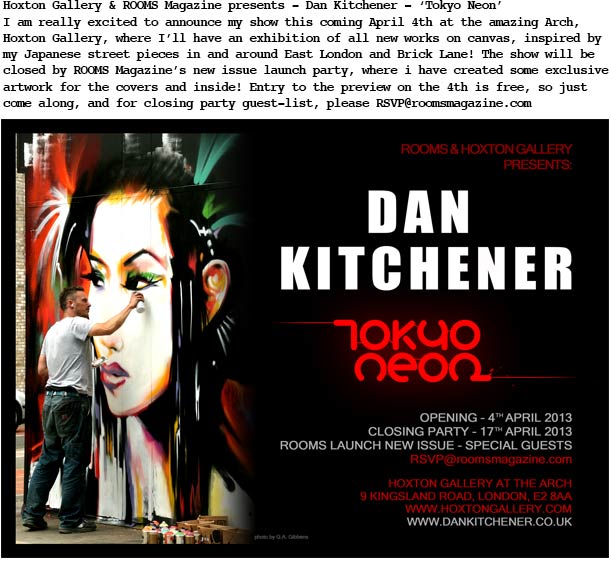
Urban Art Adventure + Dan Kitchener Tokyo Neon Opening

When I was in Sixth Form, Hoxton and Shoreditch were home to my favourite places to go out, like The Old Blue Last where I flailed to the many unknown indie bands I used to follow. Six years have passed since I was last there, and in that time the area has become the urban art centre of London. Thankfully, my Dad knows his way around and gave me a tour on Thursday that culminated in the opening of artist Dan Kitchener's Tokyo Neon solo show at the Hoxton Gallery.

Our first mission was to visit The Brick Lane Gallery to make an offer on this Basquiat inspired piece by Per Andresen, called Usuaul Problem. We're both huge Basquiat fans, and know that this is the closest we'll get to owning an original. Despite a disagreement with the woman in the gallery about the line between rip-off and homage, I'm happy to say this will soon be hanging on Dad's wall.


On our way to the gallery, Dad took me past some of the best spots for graffiti, including Cargo, home to an original Banksy, so valuable now that has to be protected behind perspex. I appreciated the yellow sock-puppety creature next to it.


On the other side of the Banksy at Cargo is this awesome fish mural. It's a shame you can't see from this picture, but I loved how while most of the picture is very realist, the nude in the middle has a smiley face that looks more like an Ecstasy tablet.


We wandered past countless other murals on our walk through Shoreditch, including this Brazilian scene near the old abandoned Shoreditch station.


I enjoyed the bright colours and cute characters of this mural by Malarky.

Then it was off to Hoxton Gallery for Dan Kitchener's Tokyo Neon, which housed a collection of spray-can paintings elebrating the beauty of neon reflections. The opening night seemed very popular and one of the paintings sold within the first 15 minutes!


Dad's friend, Andy Crosbie, is a real urban art connoisseur and long-term supporter of Kitchener. I'm very grateful to him for these photographs of two of the most striking pieces, which are far better than any I could have taken. Like Dan himself, I prefer the more abstract pictures, like the top one, but the more figurative second picture, going for £3500, seemed to be the big draw.


Tokyo Neon runs until 17 April at Hoxton Gallery.

Sunday, 27 January 2013

Reina Sofia: A trip through some of my favourite artworks

The Prado may be the most famous museum in Madrid, home to some of the greatest works in Spanish history by the likes of Goya and Velázquez, but I've now been to Madrid twice without stepping inside its doors. Instead, I'm always seduced by the Reina Sofia, home to key pieces from some of my favourite artistic movements. While my last visit was taken up with postwar art, especially Fluxus, (plus a room full of Dalí that I couldn't find anywhere this time), on my recent visit I finally made it to the centrepiece of the museum: Picasso's Guernica.


I've grown up with Guernica on the wall of my living room, but seeing it full size (11.5" x 25.5") still had an incredible impact on me. Picasso's 1937 protest against the fascist bombing attack which destroyed this civilian Basque tow confronts you the full terror and despair of the Spanish Civil War, and remains one of the most iconic pictures of all time. Reina Sofia adds to the original painting with preliminary sketches, photos of painting in progress and countless other anti-Franco/anti-Fascist works which put the piece in context. 

While many people apparently go straight to the Guernica and then head off to the Prado, it's a gallery where you really need time to study the pieces on display and learn about their history to really appreciate them. There is far too much in the galley to do this for everything, so I'd love to live in Madrid and take a room or two at a time until I'd seen the whole place properly. The Reina Sofia is like a walk through the European Avant-Garde class I took in second year - my favourite of all the courses I've ever taken - in which we explored Dada, Futurism and Surrealism. All of the key pieces from those movements are there, from the Lumière Brothers' hypnotising Serpentine Dance (1899) to Francis Picabia's Portrait of a Young American Girl in a State of Nudity (1915), exploring in very different ways the power of the machine in creating modern identities. I particularly loved seeing an original copy of Blaise Cendrars' poem The Prose of the Transiberian and the Little Jehanne de France beautifully illustrated by Sonia Delauny (enough copies were made so that if they stood end to end they would reach the top of the Eiffel Tower).


As well as the European Avant-Gardes, Reina Sofia is home to twentieth century Spanish greats: Mirò, Tapiès, Picasso (as we've seen above), Dalí, and lesser known artists like Juan Gris, all of whom prove the immense, unparalleled creativity emanating from Spain.

Picasso, The Painter and the Model, 1963
Joan Mirò, Woman and Dog In Front of the Moon, 1936
I'm looking forward to my next trip, when I can take more time to discover some new pieces.

Wednesday, 5 December 2012

Brussels: Bruegel, Magritte, music and more

I'm afraid it's been rather quiet on the blog front lately. That's because I've been jetting off - or rather Megabusing off - a lot recently. After Saturday to Tuesday in Bristol, I went to Brussels for Thursday to Sunday, for an action packed few days of art, music, inflatable lizards and lots of chips.

I was staying with my lovely friend Bethany, who works for the Quaker Council for European Affairs. The office is currently full of funky peace posters like this:


On my first night, we went to Le Cercle des Voyageurs, an amazing world food restaurant that also has a travel literature library and hosts live music, comedy, theatre and more. We then went for some late night sight-seeing at La Grande Place, where the unconventional Christmas tree is causing quite a stir. I quite like it.

The next day, I headed to the Musée des Beaux Arts following in the footsteps of Alfonso Castelao who documented every painting he saw at that museum 91 years ago in Diario 1921 (one of my three dissertation texts). My mission: to find Peter Bruegel the Elder's The Fall of the Rebel Angels (1562).


As I wrote in a previous post, Castelao didn't hold back on his criticism of the vast majority of art housed in the museums of Paris, Brussels and Berlin. However, he adored the Flemish masters, and was even inspired by them to create his own sketches called 'Things that occur to you in a Brussels café'. It's easy to see why he loved this painting so much, copying parts of it (particularly the toad ripping itself open) into his notebooks. While other Bruegel paintings are more famous - especially The Fall of Icarus - I was just mesmerised by this painting, staring at it for a good 20 minutes and constantly finding new things. I love the weirdness of all the creatures.


As well as Bruegel, I was on the look out for Hieronymous Bosch, and particularly the Temptation of St Anthony triptych, another painting populated with amazingly demented characters. A picture cannot do it justice, as you can't make out the incredible detail of every face and every demon.


Talking of demons, I love these from a Last Judgement - wish I'd written down whose it was. Religious art was so much fun in the 15th Century!


Sticking with demented figures, but from four centuries later, I really liked this portrait by Antoine Mortier from the exhibition about abstraction as a response to World War II.


Again I stupidly didn't write down who this one was by, but it was part of the same reactions to WWII collection.


The Musée de Beaux Arts is joined to the Magritte Museum, a must see for a surrealism junky like myself. I spent several hours there, learning more about the artists work and enjoying the vast collection of his works which question the meaning of words, images and symbols.


The art's not just in the museums but on the streets too. Brussels is famous for its moulles, but I've never seen one like this before!


That night, after a very traditional Belgian dinner of frites, we went to a party at Beursschouwburg celebrating 10 years of Globe Aroma. The star attraction was a Kurdish/Iranian band called Mozaiek Musik, who lived up to their name, combining rhythms, songs and instruments from the Middle East, Europe and Latin America. They had the whole packed venue flailing.

The next day continued on a musical track with the Musical Instrument Museum. Housed in a beautiful old Art Nouveau department store, the MIM brings together folk instruments from around the world, mechanical music makers across the ages and more varieties pianos and violins than you can imagine. You're provided with infra-red headphones, so when you get close to an instrument, you can here what it would have sounded like. Weird and wacky instruments abound, but my favourite was this fishy relative of the lute from Portugal - you can't really see, but it even has real teeth!


Last stop, the Christmas market. The market had everything you'd expect: vin chaud, sausages, chips, chocolates, hand made tat... And then there was a giant inflatable lizard, or 'incredible Christmas ice monster'. If you dare to journey inside, you can explore the beasts internal organs and learn how they work. Infotainment at its best. Unfortunately I was a little too old to go in :(


And that's about all I had time for. I'm looking forward to another, warmer trip to Brussels at some time next year to soak up even more of the amazing range of culture on offer.

Saturday, 27 October 2012

Ways of Seeing, John Berger and Imagometia

2012 marks the 40th anniversary of two of John Berger's most famous works: Ways of Seeing, his seminal BBC TV series about the nature of art as property, and G, his Booker Prize winning novel. It also sees the culmination of almost two years of work by Tom Overton, cataloguing sixty years worth of documents donated by Berger to the British Library, as part of a joint PhD between that institution and King's College London. That work has resulted in an exhibition at the Inigo Rooms in Somerset House, running until November 10.

Berger at the exhibition, photographed by Greg Veit, official photographer of AHFest
Tom was kind enough to give us a private tour of the exhibition, which combines unseen documents with artworks related to Berger's life to provide a unique insight into one of Britain's greatest art commentators. Until 2009, these documents had been boxed up in a shed at Berger's home in rural France, in old fruit crates. Tom probably gave himself lung cancer breathing in all the cigarette smoke absorbed by the documents from Berger's chain-smoking but assures us that it was worth the sacrifice to get a deeper understanding of Berger's way of working and correspondence with others.

According to Tom, Berger's father was also the 'father of modern accounting', meaning that young John was sent from his home in Hackney to private school in Oxford, expected to become a middle-class professional. Instead, Berger went to art school and became committed to Marxist humanism, as is evident throughout his works and the correspondence on show here. The exhibition includes a painting of the late Eric Hobsbawm, one of many British Marxist intellectuals with whom Berger would meet and discuss politics, as well as a selection of Socialist Realist paintings.

One thing the archives make very clear is Berger's penchant for cutting and pasting, from long before Microsoft Word. His notebooks are full of newspaper clippings or notes scribbled on the back of envelopes precariously sellotaped into manuscripts in progress. The archive also highlights the collaboratory nature of Berger's work, creating projects with many artists, photographers and film-makers. One of my favourite parts of the exhibition is the documents behind I Send You This Cadmium Red, a book which brings together the years of correspondence between John Berger and John Christie that began with sending a small colour sample (you can buy the book here).


Tom is full of anecdotes about Berger's life and work. A particular favourite is how Berger, who did not approve of literary prizes, donated half of his Booker Prize money to the Black Panthers, allowing them to acquire a building for their headquarters. However, Berger's philanthropy backfired in an unexpected way: all the members of the group moved in together, then swiftly all slept with each other, had huge fights and the movement broke up!


To tie in with the exhibition, a performance piece was specially commissioned for the King's Arts and Humanities Festival:  Imagometia, by Rafau Sieraczek. Inspired by Berger's seminal work, as well as Jacques Ranciere and Guy Debord, the performance aimed to make the audience reconsider how we see things. We were split in two, one group on either side of the stage, and told not to look around, as we were shown videos and dance performances. After a while we were made to swap sides: the same music played, but the images were different, making us question whether we were seeing the same thing as those on the other side of the room. Moreover, we were provided with mirrors and blacked-out glasses, which meant we could only see behind us or out of the very corner of our eyes, again making us question the traditional way of viewing art and performance straight on. Sadly, the event seemed to lose its way after a while, descending into a parlour game: one participant, blindfolded, had to describe an object in his hands to another who had to draw it from his words - an interesting concept, but sloppy in practice. Nonetheless, we all left Imagometia wish fresh ideas about how to view art and performance - John Berger would surely approve!

Friday, 6 July 2012

BT ArtBoxes

I've seen pigs in Bath and gorillas in Bristol; now BT are filling London with vibrantly decorated telephone boxes, in honour of 25 years of Childline. On Wednesday I spotted a few, but from the website -  www.btartboxes.com - it looks like there are many much more exciting ones out there. Keep your eyes peeled if you're in London over the summer.

How Many People Can You Fit Into A Phone Box? by Dan Woodger
BT explain that as the red phone box was designed by Sir Giles Gilbert Scott to mark King George V's Silver Jubilee, they launched these artistic replica boxes to coincide with the Queen's Diamond Jubilee. The boxes will later be auctioned to raise money for Childline.

T is for Telephone by David Mach

Wednesday, 13 June 2012

Spike Island Gallery, Bristol

As well as graffiti spotting, we decided to check out some more free art of the indoors kind in Bristol over the weekend, which led us to Spike Island, just around the harbour from the SS Great Britain. Spike Island is a contemporary art space which hosts visiting exhibitions as well as work-space for artists.

The first exhibition we saw was the summer show of the Fine Art students from UWE (University of West England). Mainly a mixture of objets trouvés, video art, and piles of junk (literally), a lot of the work didn't seem like it took much talent to devise or make. I'm not a huge fan of art that's controversial for the sake of it, or trying to fool you into thinking it's better than it is, so we quickly moved on.

UWE students working in the Spike Island studios
Next up was an exhibition of artists' postcards (showing until Sunday 17 June). "Artists' postcards" was taken very loosely, meaning everything from holiday postcards sent by artists to postcards of artists' works; traditional photography, Dada, Fluxus, poetry, cartoons and more. All of the works exhibited came from the personal collection of writer and novelist Jeremy Cooper who has just released Artists' Postcards: A Compendium.


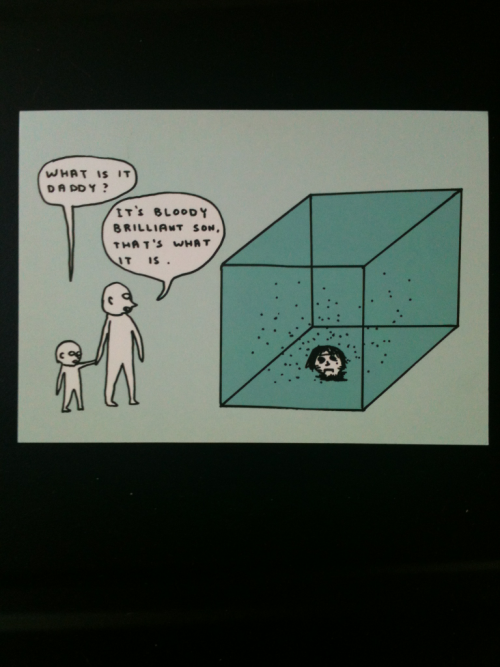
One of my favourites was this David Shrigley drawing mocking Damien Hirst, called Brilliant.


Apparently saving the best til last, we came to Crepe Suzette, the first UK solo exhibition by Daniel Drewar and Grégory Gicquel (also running until 17 June). The main attraction of this exhibition is a range of stop-motion animations which depict clay sculptures in various states from lumps of clay to fully formed figures, all shot out in natural locations (lakes, forests etc), creating a commentary on the ephemeral nature of art. My favourite video was one in which clay legs seemed to dance across the screen, as they kept being made, destroyed and remade along the lump of clay - putting some fun back into sculpture!