Sunday, 12 August 2012

English Language Centre Social Programme: Week 1

I've now been working at the Social Programme at the University of Bath's English Language Centre for a week and a half. As the complete lack of posts this week proves, the job has been keeping me very busy. I have actually started writing several posts in this time, but haven't had a chance to finish any of them! I hope to rectify this now, starting with weekly updates of our activities and what aspects of British culture we have been sharing with the students.

This week is a bit of a strange one, though. The weekend was one of the busiest of the summer, with many groups either leaving or arriving. Consequently, much of our time over the last week has been spent preparing for arrivals, loading people onto coaches, settling people in and dealing with any issues along the way, meaning that we have had less time for other activities. In addition, as one of the more experienced people in the office (returning for my second year in the Social Programme) I tend to stay on campus doing admin (I am a bit of a photocopying addict now) while others are out on the trips. So, there are only two activities for this week's round-up (plus a Saturday trip coming up in the next post).

Skittles @ Widcombe Social Club


We describe skittles to our students as a traditional British pass-time, but I imagine it's not the most popular activity these days. The other student helpers and I had certainly never played before this job. It's a shame though as it's actually really fun - like bowling, only more difficult. Part of the fun is certainly the competitive element though - I was the leader of 'Team Katie' and desperately cheering on my team throughout the night. We came second :(


Live Music @ The Bell - Count Bobo and The Bullion
Live music obviously isn't limited to Britain, but going to a local pub for a free gig is certainly something that lots of locals enjoy. The Bell, especially, is a spot well-loved by Bath residents, so our students got to chat to  many people as well as enjoying the ska-jazz fusion of Count Bobo and The Bullion (photographed by fellow student helper Bethany Squire). You can listen to their music here.


We had a great time dancing along to some of the more energetic tunes, and my new Turkish friends (on the ends, with me and a Czech girl) even tried to teach me how to belly-dance. I failed!

Wednesday, 1 August 2012

All Change Please

Over the last few days I've been very busy packing, cleaning and unpacking again as I move from Cardiff to Bath. I've had a wonderful year in Cardiff, as this blog will attest, especially thanks to the local institutions like Sherman Cymru and Chapter which welcomed me so warmly. Now, though, it's time for a new adventure.


For the next two months, I will be working at the English Language Centre at the University of Bath. Having completed my degree here, Bath feels like home, so I am very happy to be back, and even more so as I have lucked into a room with spectacular views of the Abbey, spa and surrounding countryside. Part of my job involves introducing international students to British culture, so expect many entries over the next few weeks about our events, from Shakespeare in a field to folk music, as well as the usual rants about what I'm reading or watching. I'll miss Cardiff and it's vibrant cultural scene, but I'm sure Bath will have plenty to keep me busy!

Sunday, 29 July 2012

The White Nights - from Dostoevsky to Visconti + Bresson

Writing about Notes from Underground just now made me realise I never finished and published this post from way back in January. Here it is only half a year late.

Classes have started again, whoo! It may be incredibly geeky but my life seems a bit lacking in purpose without learning to do. And as I'm paying so much for this education, I might as well share it with you.

The first course to begin is called Crossing Borders: Adaptation from Literature to Film, which brings together a whole load of things I love, and the first adaptation we're looking at is The White Nights (full text available here).


The White Nights is a short story by Dostoevsky (1848) telling the story of a dreamer and the four nights he spends with an impossible love. This story has often been written off as just a minor Dostoevsky novella, nothing more than a romance. But my teacher, Fabio Vighi, argues that it's much more than that. This is the turning point for Dostoevsky, the moment when he moved from radically political texts to complex psychological ones, anticipating Freud's theory of the unconscious and the split-subject and thus creating the modern anti-hero far before the modern period itself. How do we get all that from a fifty page novella? In fact, it's just from a few lines here and there, lines you may well pay no attention to if you're not looking for them, but those few lines have an incredible depth of meaning. It's the story of a nameless young dreamer who is a bit of an outsider, but seemingly happy in his misery. One night he meets a crying woman, Nastenka, and falls for her over the three consecutive nights until her wayward lover returns. He is sad, of course, but happy to be sad as it gives him a life experience that makes him special.

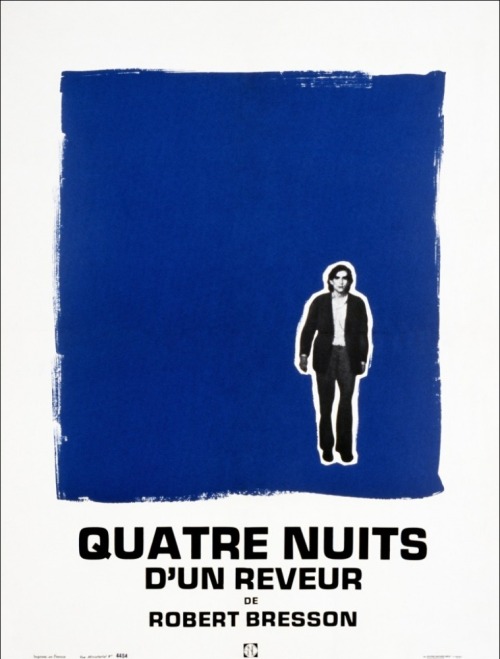
In comparison we looked at Visconti's Le Notti Bianche (1957) and Bresson's Quatre nuits d'un reveur (1971).


I found Visconti's adaptation much more interesting than Bresson's. Set against a background of post-war poverty, Visconti's film subtly reveals his communist convictions, reminding viewers that while the protagonists are caught up in their own drama, people are starving and homeless. The psychological side to Dostoevsky's novella disappears as the story becomes a much more common melodrama. Mario (Marcello Mastroianni) doesn't revel in his own misery like Dostoevsky's (anti)hero; he puts everything on the line to win Natalia (Maria Schell), and is genuinely devastated when it doesn't work out. Interestingly, the script has barely changed from the novella, except that large sections of the narrators monologues are removed and a few scenes are added in (including a spectacular dance scene in a night club). In a way then, Visconti is less progressive than Dostoevsky almost a century earlier.

Another notable aspect of Le notti bianche is its treatment of women. There are three very clear stereotypes in the film: Natalia is the innocent virgin (blonde and doe-eyed), then there is a prostitute scene wandered the city, dark and dangerous, and finally there is Mario's housekeeper in the role of the nagging mother. Fabio argues this is a  criticism of heterosexual relationships from Visconti who had to keep his homosexuality quiet - the woman may seem beautiful and appealing at first, but she won't age well and will just nag you death in the end (at this point Fabio turns to me, the only girl in the room, and apologises). This is certainly not an idea present in Dostoevsky's novella, in which Nastenka remains an untouchable ideal.


Robert Bresson's film, by contrast, remains much more faithful to the original, and yet so boring. I am a big fan of French film (as this blog will attest) but 'French' in its derogatory sense (i.e. the worst stereotypes of French cinema) is the most applicable adjective for this film. Our lonely boy this time is Jacques (Guillaume de Foret), an artist, who wanders Paris leering at women (just following them and staring at them for an uncomfortably long time) and recording existentialist musings and pigeon noise in his tape-recorder to play back to himself later. The nature of artistic creation is at the heart of Bresson's adaptation (one of the few sections of dialogue not taken directly from Dostoevsky is a diatribe from a classmate of Jacques about what makes good art), and it is clear that Jacques' interest in Marthe (Isabelle Weingarten) is primarily as a source of inspiration for his paintings. When she leaves him alone again, he goes happily to his canvases to turn the experience into art. Compared to Mario's simple, ardent passion for Natalia in Le notti bianche, this feels like a real let down even though it is far closer to Dostoevsky's original. Proof that fidelity isn't necessary the best quality on which to judge a literary adaptation! 

Notes from Underground - Eric Bogosian

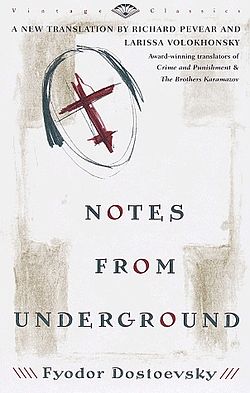
I've been reading a lot lately, so time for another book post. Browsing the library's contemporary American section recently, I spotted Notes from Underground by Eric Bogosian (1993). I'd never heard of Bogosian before (although he wrote Talk Radio which I have on newspaper-giveaway DVD) but I was instantly hit by title, sure that it was a very famous, highly recommended book.


Turns out it is, only Dostoevsky wrote it. I only just realised this when I googled for a picture of the cover, and it came flooding back to me that we'd discussed Notes from Underground as the first existential text as part of a class on Dostoevsky's White Nights. Oops. I will have to read the 1864 story now.


Written 119 years later, Bogosian's Notes takes more from the great Russian than the title; both are written in the form of a diary by an unhappy outsider. Bogosian's underground, however, is a small flat in contemporary New York, and his outsider is addicted to cheese crackers, spying on his neighbours and watching Dan Rather on CBS News. It's very short - just 70 pages, often with only a few lines on each - and written in a conversational style that makes it easy to power through, but it is far from a comfortable read. The protagonist becomes increasingly disconnected from society and its rules. He's not at all your usual murdery torturey psychopath, but more disturbing in a way as although he does not harm anyone (except himself in a particularly gruelling scene) there seems to be no logic to his actions and you never know what he might do next. It's certainly not the best book I've read recently, but an interesting study of a character isolated and adrift in the modern world.

Any Human Heart

As a treat for finishing my dissertation (well, at least until my supervisor reads and critiques it), I re-watched Channel 4's wonderful mini-series, Any Human Heart, which first aired in late 2010. Based on William Boyd's 2002 novel of the same name, it is both a very individual tale of one man and a complete history of the twentieth century. I've never found anything else that so perfectly combines so many of my interests: identity construction and reconstruction, self and history, writing and memory, artistic and literary history... all that plus romance, action, humour and an incredible cast.


We are an anthology, a composite of many selves - William Boyd

Over four episodes (about an hour and a quarter each), we are introduced to the many sides of Logan Mountstuart, from young and earnest aspiring writer through to serene octogenarian. It is not just age that changes Logan but the multitude of ordinary and extraordinary experiences that make up his long life. Living from 1906 to 1991, Logan not only witnesses, but actively participates in, the events which so drastically changed our world over the course of the twentieth century. From the Spanish Civil War and World War II to left-wing terrorism and Thatcherism, Logan writes about it all alongside banal details of everyday life. It's not just politics that graces Logan's journal either, but, as you'd expect from a 'man of letters', the vagaries of art and literary fashion. From Hemingway to Prince/King/Duke Edward, Logan fortuitously interacts with many of the most famous names of the twentieth century.

Jim Broadbent, Matthew Macfayden and Sam Clafin
as the three ages of Logan Mountstuart
At the same time, Any Human Heart is deeply personal. Each stage of Logan's journey through the twentieth century is marked by one of his many women, yet his love for one particular woman lasts his whole life and outweighs everything else. This is my favourite part of the story, beautiful and heartbreaking. Logan's philosophy is that "It's all luck in the end: good luck and bad luck". He is a man who experiences plenty of both and carries on regardless.

I know the novel has even more to offer that couldn't fit into five hours of TV, and so look forward to reading it soon. I particularly like how Boyd tries to pass it off as a real diary, with an editors preface, footnotes, list of works by Logan Mountstuart, and all the other trappings you would expect of an edited volume. Boyd had previously written a biography of a fictional artist, Nat Tate: An American Artist 1928-1960 (1998) which had been so realistic it had fooled many art critics. His blurring of the lines between fiction and reality is just another reason why I'm so fascinated by his work.

Any Human Heart is available to watch on 4oD. You can buy the book on Amazon here

Thursday, 26 July 2012

The Bonfire of the Vanities

My latest article for Bibliomula is out now, but if you don't speak Spanish, here's what I wrote about Tom Wolfe's The Bonfire of the Vanities in English.


New York has always seemed like a spiritual home for me. I grew up with images of the city, from television, films, books and the stories told to me by my father who had lived there for a few years. Central Park, the Empire State Building and the Metropolitan Museum of Art have long been familiar to me, although I only visited New York for the first time last year.

New York is billed as the place where "dreams come true", where anyone can get rich or find the love of their life atop the Empire State - perhaps even both on the same day. But unlike the fairy tale, what has always fascinated me most is the other side of the megalopolis, its hidden, sordid side. From American Psycho by Brett Easton Ellis (1991) to Cosmopolis by Don DeLillo (2003), novels that juxtapose the high life of wealth and beauty with violence, corruption and depravity never fail to draw me in. Morally bankrupt characters are always the most engaging. And undoubtedly the masterpiece of the genre is The Bonfire of the Vanities by Tom Wolfe (1987), an epic for the modern age that paints a bleak picture of all of New York, from the Bronx to Park Avenue.
TomWolfBorn in 1931, Wolfe became famous for his trademark white suit and the invention of 'New Journalism'. Departing from the traditional idea of journalism as impartial and formal writing, Wolfe pioneered a creative and experimental journalism. His greatest talent is the true-to-life reproduction of speech, incorporating slang, phonetic spelling and erratic punctuation, which gives his stories a sense of urgency and a real spark. In the sixties, his non-fiction books - The Kandy-Kolored Tangerine-Flake Streamline Baby (1965) and The Electric Kool-Aid Acid Test (1968) - captured the spirit of the age: experimentation, psychedelia, freedom.
When money and power took the place of freedom and self-expression as the dominant values ​​of the eighties, Wolfe used all of his experimental literary techniques to create The Bonfire of the Vanities, a captivating portrait of the New York melting-pot, inspired by William Makepeace Thackeray's Vanity Fair (1848), presenting a cross-section of contemporary society. The title also refers to a medieval Florentine ritual in which objects accused of inducing sin were burnt; an apt title for a novel full of all manner of sins.

The novel is set in a key period in the recent history of the United States, marked by racial tensions and the height of Wall Street power. It starts in the Bronx, where racial tensions reach boiling point and violence erupts. This chaos is then juxtaposed with the trading floor of Pierce & Pierce, where Sherman McCoy is the star stockbroker. Everyone shouts and swears here too, but on the trading floor they do it for a six-figure salary. Between these extremes, orbit a growing list of characters. There are the manipulating English, like journalist Peter Fallow, who charm American wannabes into paying for their binges. There are the assistant district attorneys, like Larry Kramer, who struggle to make do with meagre salaries while getting off on the power to imprison criminals. There are the schemers like Rev. Reginald Bacon, who accuse everyone of being racist and incite violence in order to further their own careers. When Sherman has an accident with fatal consequences, it reveals how all these worlds are interrelated and are a lot more than it first seems. Rich or poor, everyone is after the same things: sex, status, power. Everyone exploits everyone else for their own benefit.

One of Wolfe's key achievements was counteracting the myth of Wall Street as the Promised Land. He describes in detail lavish dinners and luxurious apartments which 'haemorrhage money', to show how just vacuous they are. Although he refers to himself as 'Master of the Universe', Sherman is not happy. He is obsessed with money and seeks solace in a dingy apartment with a young lover. Behind the veneer of decency, the rich are as immoral as the criminals in the Bronx.

While it may seem heavy (physically and in terms of content), The Bonfire of the Vanities is actually full of humor and action. In Wolfe's typical style, there is no omniscient narrator, which keeps the reader guessing. The events are told again and again from different points of view, manipulated for political gain, exaggerated to sell newspapers, spread through backstreet whispers. At each point, the reader is never sure of the truth and Wolfe revels in the ambiguity.

It is now twenty five years since Wolfe wrote The Bonfire of the Vanities. Has New York changed? The city has gone through Guiliani's 'clean-up', shared with the rest of the country the arrival of the first black president in the history of the United States of America and witnessed Wall Street reforms, so you would hope that crime, racial tensions and wealth inequality, would decrease. However, a quick glance at the news suffices to prove that all these challenges persist. Moreover, if there's one thing I've learned from Gossip Girl (the TV series, and novels by Cecily von Ziegesar on which it is based), it's that Sherman's world is still very much alive. The wealthy New Yorkers continue to live extravagant and luxurious lives, full of vice without consequence.

The Bonfire of the Vanities is a book that you can't put down. An enduring study of human character and a historic document in equal measure. It captured with precision a fundamental era, whose presence is still keenly felt in New York today.

Sunday, 22 July 2012

Literary tunes

I've just finished reading Rudyard Kipling's The Man Who Would Be King, which I downloaded (free for Kindle - yay for expired copyright) primarily because I love The Libertine's song of the same title. In that vein, I thought I would share a few of my favourite songs based on literature. I know there are a lot more out there (including some very obvious ones like Kate Bush's Wuthering Heights), so please comment with your favourites.

The Libertines - The Man Who Would Be King
I don't think the song actually has much to do with the story beyond the title and a mention of newspapers, but it's been stuck in my head for days while I've been reading Kipling's 1888 novella. In the same way I could mention their What Katie Did single, apparently about an ex-girlfriend of Doherty's but sharing its name with Susan Coolidge's 1872 children's book.


The Velvet Underground - Venus in Furs (Leopold von Sacher-Masoch)
As it is named after the 1870 book that introduced Masochism to the world, it was once my psychology homework to listen to this 1966 track, which remains one of the coolest songs ever.


Elefant - Lolita (Vladamir Nabakov)
Lots of songs are named after Nabakov's iconic 1955 tale of a highly inappropriate attraction, but I love Elefant's for the rock-factor. It's a shame the band totally disappeared.


Broken Records - If Eilert Loevborg Wrote A Song It Would Sound Like This (Ibsen, Hedda Gabber)
I'm listening to Broken Records as I write this, so this had to be on the list. Ibsen's plays pack quite a punch (especially for the 19th century) and so does this song.


Jefferson Airplane - White Rabbit (Lewis Caroll, Alice's Adventures in Wonderland
Another obvious one. Caroll's surreal stories fit perfectly with the 60s psychedelic vibe.


Ridan - Ulysse
There must be hundreds of songs inspired by Homer's Odyssey/Joyce's Ulysses, but as this list has been dominated by cool American rock, so I thought I'd mix it up with a little French urban protest music. I particularly like the siren (mermaids/police cars) pun.


Honourable mention: Jamie T - Sheila 
While not based on a book, I love the sampling from George Bernard Shaw's Pygmalion in the middle of the song: "Good Heavens what a noise! Cold blooded murder of the English tongue. BRAAAA!"