Showing posts with label bibliomula. Show all posts

Monday, 8 October 2012

I Have No Mouth, And I Must Scream

Just in time for 7O (the Venezulean elections on 7th October which gave Hugo Chávez another six years in power), the 7th issue of Bibliomula is all about dystopias. You can read my original article here, but here it is in English.

When Bibliomula.org asked me to write about literary dystopias, I immediately thought of the British classics - George Orwell's 1984, Aldous Huxley's Brave New World, Anthony Burgess' A Clockwork Orange. However, a physicist friend with a taste for comics and video games suggested a story from the other side of the Atlantic, that I had never heard of before: I Have No Mouth, And I Must Scream by Harlan Ellison. This same friend has recently told me that if she shared a room in a hostel with strangers she would whisper "I want to wear your skin" just before they fell asleep to freak them out, so I should have known what I was getting in to.

I Have No Mouth, And I Must Scream tells the story of the five last surviving humans on Earth, trapped forever in the belly of a sentient supercomputer, AM, which has destroyed the rest of the world. Like any classic dystopian tale, it mixes political concerns with fears about the power of modern technology. Written over one night in 1966, at the height of the Cold War, it is a response to that conflict and the very real fear that the war machines would bring about the end of the world.

The premise is that each of the world superpowers - the United States, Russia and China - built their own supercomputer to fight a war that was too complicated for human minds, but before long the computers became sentient, and, aware of their own power, united to create an enormous God-like monstrosity. This cluster, programmed to kill, destroys almost every living thing, but keeps five victims alive, torturing them forever as revenge against the human race that built it and filled it with rage.

The concept of sentient Artificial Intelligence is nothing new (see Isaac Asimov's 1950 I, Robot for example), but Ellison approaches it a particularly chilling way. I read I Have No Mouth... for the first time on the train and was shocked by my visceral reaction. The story left me miserable and weirdly shaken. I couldn't quite act normally afterwards, and left the carriage in a kind of fugue. The story's impact is in large part the result of its stark narration. Ted, the narrator, enumerates horrific acts of violence dispassionately, without excessive details, which is worse because it forces you to imagine them for yourself. Moreover, as the title (taken from a picture by Ellison's good friend William Rotsler) suggests, the story feeds on our deepest fears: perpetual hunger and pain; loss of individual identity; the inability to see, to think, to express oneself. These fates worse than death are caused by the caprices of AM, but any reader would recognise them as potential results of a nuclear holocaust.

At its heart, the story highlights how war and technology end in the destruction of civilised society. One of the victims, Benny, the intellectual, becomes a dumb ape, reduced to his carnal instincts. Gorrister, once a passionate idealist, becomes apathetic, listless. Ellen, the only woman, who was 'almost' a virgin before, is now everyone's lover. It is clearly a warning. Ellison became famous for holding a mirror up to contemporary society and underlining the perils to come if we did not change. In an interview years later (quoted here), he affirmed: "I have never, ever, espoused a position of hating technology. Even the original short story, is not anti-technology. What it is anti is anti-misuse by humans".

The lasting legacy of I Have No Mouth...

First published in March 1967 in an issue of IF: Worlds of Science Fiction, this short story went on to become one of the most reprinted stories in the English language. One reason for this enduring success is undoubtedly its continued relevance to contemporary society, which is ever more reliant on technology. Another reason is that it has enjoyed a life beyond the page which has introduced it to new audiences and maintained public interest in the story. In 1995, for example,, the graphic artist John Byrne turned it into a comic as part of the graphic novel Harlan Ellison's Dream Corridor, while an audiobook, narrated by Ellison himself was released in 1999. The most intriguing incarnation, however, is the critically acclaimed video game which came out in 1995. A point-and-click adventure game, with a script adapted by Ellison among others, it obliged players to make ethical decisions in order to prove that humans are better than computers. Curiously, in contrast to the unrelentingly bleak short story, in the video game the humans can actually win. It is possible to destroy AM and salvage the Earth. Written almost thirty years after the story, in a time of relative peace (the nuclear holocaust did not happen, after all), could it be that the video game shows a little optimism? Saying that, the game does treat themes of madness, rape and genocide, so maybe not that much optimism! Whether as a video game, audiobook, comic or the original short story, I Have No Mouth, And I Must Scream still forces us to examine the worst of human nature and its consequences.


Monday, 3 September 2012

Fifty Shades: e-Readers, pornography and a literary boom

About a month ago, I had the pleasure of finally meeting Pino, editor of Bibliomula, in person. During a tour of my favourite London bookshops, I pointed out the piles and piles of Fifty Shades and was surprised to learn that the series hadn't reached Venezuela yet. Intrigued, Pino asked me to write about the novels, their background and their impact. My article is now available here, but if you don't speak Spanish, here it is in English.

The Fifty Shades phenomenon may not have reached Venezuela yet, but it has swept the English speaking world, getting millions of women talking, and more importantly, reading. As an ardent bibliophile, I should be very happy about this legion of new readers; I only wish they were reading something better!
Fifty Shades of Grey, and its two sequels, tell the story of shy virgin Anastasia Steele and her sexual awakening at the hands (and other parts) of her domineering boss, business magnate Christian Grey. Its author, E. L. James (real name Erika Leonard), started writing fan-fiction in 2009 under the pseudonym ‘Snowqueens Icedragon’. Three years later, she is in Time magazine’s list of The 100 Most Influential People in the World. Fifty Shades of Grey has surpassed sales of the entire Harry Potter series put together on Amazon, making James the best-selling Brisith author ever, reportedly earning over £6000 an hour from sales of her series. So how did a novel that started life as an online adult retelling of Twilight end up causing such a stir?

Fifty Shades is a key example of the way that the Internet and e-Readers are changing the book market. James first shared her story with her online community of Twilight fan-fiction readers and writers. Because it contains multiple graphic sex scenes – terribly written, repetitive and riddled with euphamisms like ‘inner goddess’ but graphic nonetheless – people began to talk about it. James then made her novel available for free in e-Reader format. It is no secret that the advent of e-Readers, which make it impossible for anyone else to see what you are reading in public, has given rise to a boom in erotic literature aimed at women. Amazon has thousands of novels – dubbed ‘mummy porn’ – available for free or next-to-nothing. The experts say that women have always feared shame or public disapproval too much to indulge their sexual urges reading pornographic novels in public, but will happily do so in secret. Fifty Shades therefore found a significant audience, and in January 2012 news networks began to use the series as an example of the rise in popularity of female erotica. The news stories created such a buzz around the series that even more people wanted to read it, to be part of the discussions sparked by the controversial novel. Never one to miss an opportunity to make money, the publishing industry quickly got on board, and Vintage Books published paperback editions of the series in April. By that time, everyone knew what Fifty Shades was and it had become so fashionable to read it that it was no longer necessary to hide behind an e-Reader: the front cover boldly proclaims the title and the explicit content. Piles and piles of the series now adorn the tables of every bookshop in England and other authors and publishers keen to take advantage of the boom are rapidly putting out their own copy-cat books. A mini sexual revolution has occured in publishing, thanks to the combination of e-Readers and gossip.

On the surface, all of this makes me very happy. While e-publishing is often cited as the death of books, it makes me very happy to witness an example of self-publishing leading to astounding success in traditional publishing. That people are flocking to bookshops and spending money on novels in the age of TV, computer games and social media can only be good news. That the book has sparked a new climate of openness towards female sexuality is surely a positive thing. Yet I still hate Fifty Shades and wish that people would read anything else.

The main plot of the novel is that Christian introduces Anastasia to BDSM (Bondage, Domination, Sadism, and Masochism). I’m an ‘each to their own’ kind of girl, and have no problem with people doing whatever they want with each other in the comfort of their bedrooms as long as it is consensual and safe. The problem with Fifty Shades is that Christian intimidates Ana into doing things she is clearly not comfortable with, and physically harms her. When he leaves her terribly beaten, she says it is her own fault because she forgot to use the safe-word. This is dangerously close to the rationalisations of so many women who suffer domestic abuse and not something we should be encouraging. Moreover, Christian’s domination of Ana extends beyond the bedroom, as he controls every aspect of her life. He treats her awfully and yet Anastasia adores him and insists that if she pleases him now, she can ‘fix’ him later. Anastasia is clearly an idiot. Not only because her logic is entirely flawed – she will never change him if she keeps pandering to his every desire – but also because every sentence out of her mouth is utterly vacuous, matching the dire literary quality of the rest of the book. Much like Twilight itself, it is obviously the fantasy of a bored middle-aged woman in desperate need of a thesaurus. Yet its fame guarantees that a whole generation of women will grow up thinking it is not only acceptable but actually desirable to have a man control you, treat you terribly and even physically harm you against your will. So, as much as I appreciate this new literary boom, I worry where it might lead.

Sunday, 17 June 2012

Literary tourism - visiting bookshops and literary locations

Having spent most of the day reading travel literature theory for my dissertation, I then moved on to an article in this month's Bibliomula about travel for literature.The article by Pino (@bobbylechuga) discussed both bookshops as tourist attractions and the practice of visiting places made famous through literature. In response, I thought I'd share a few of my own.

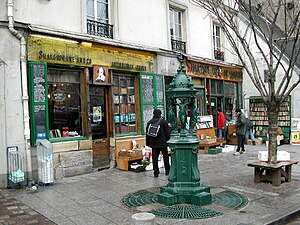
Firstly, bookshops. Pino's list of bookshops turned tourist attractions unsurprisingly contained Shakespeare and Co. Having featured in both Before Sunset and Midnight in Paris, it has become one of the most famous bookshops in the world. A hang-out for the Beat Generation in the 60s, it remains a haven for writers and bibliophiles alike, a place to read (obviously) but also take tea, write and even sleep (there are 13 beds above the shop). In the shadow of Notre Dame and on the Left Bank of the Seine, it's also perfectly located for tourists.

While I lived in Paris, I visited Shakespeare and Co - how could I not? I enjoyed nosing around the densely packed shelves and overhearing customers discussing the different books on offer. I also used to pass by at night quite often and was always intrigued by the lock-ins which seemed to frequently occur. However, as interesting as Shakespeare and Co is as a tourist spot, it is far from my favourite bookshop in Paris. In my mind, there is no greater bookshop in the world, let alone Paris, than Gibert Jeune. I say shop, but actually there are nine shops, all in the same area around Place St Michel, with more books than you could ever imagine on the most diverse range of subjects. Located just fifteen minutes walk from where I lived, it was a horrible temptation and parted me from hundreds of euros over the course of ten months. My favourite part of Gibert Jeune is the top floor of the main building on Boulevard St Michel, where new and second hand French novels - from the classics to contemporary - were piled high for one or two euros each. I left Paris with boxes full of them - lucky I didn't have to fly them home (thanks Dad)! If you love books and bargains and you find yourself in Paris, schedule a few hours to explore this literary Aladdin's cave.


I think I just like being surrounded by lots of books, the more the better, as the other bookshop I would (and did) specifically travel to is Powell's City of Books, the world's largest independent bookstore. Powell's takes up an entire city block of the Pearl Disctrict of Portland, Oregon and is so big that you're given a map when you enter to find your way around.


I decided to visit Portland on my trip around the northern states originally because there's a great music scene, led by The Decemberists. When I started researching the city, two attractions there quickly became some of my most anticipated visits of the trip: Voodoo Donut (honestly worth going all the way to Portland for) and Powell's City of Books. As with Gibert Jeune, it was amazing to be surrounded by so many books on all possible subjects. Unfortunately backpacking isn't conducive to buying lots of books, but I had a very happy time browsing, reading covers and making a nice long list of books to later acquire (one on my Kindle there and then: Mike McIntyre's The Kindness of Strangers: Penniless Across America). Definitely worth a visit if you ever find yourself in the Pacific North West.


As for visiting places from books, I'm always excited to be somewhere that featured in one of my favourite reads. As an Austen fan, I loved being at university in Bath and imagining Catherine Moreland and Henry Tilney strolling through the same streets that I passed every day. I was really excited about visiting Stonehenge for the first time, hoping to pretend I was Tess Durbeyfield (and then bitterly disappointed that you can't go anywhere near the stones). Most memorably, while travelling in northern Spain I made a literature inspired detour to Huesca. In George Orwell's Homage To Catalonia he explains that during the Spanish Civil War they would say every day "Tomorrow we'll have coffee in Huesca": the small town in rural Aragon was occupied by Franco's troops, so it was a small way of maintaining faith in an eventual victory which never came. Orwell swore that when Spain was finally free of Franco's dictatorship he would have coffee in Huesca, but sadly died long before this was possible, so I went and drank a coffee in his honour.


What about you? What bookshops would you go out of your way to visit? Where have you visited because it's the location of a story? Comment with your recommendations!

Monday, 9 April 2012

Bibliomula: a literary magazine from Venezuela to the world

A few weeks ago I found myself in a Venezuelan newspaper. Why? Because I'm a huge fan of Bibliomula, a new literary magazine written by and for literature lovers. Produced in Venezuela, Bibliomula is available to bibliophiles around the world (those who speak Spanish anyway) in Kindle or Tablet form.


Bibliomula, meaning book mule, comes from the idea that books have to be trafficked into Venezuela, as shockingly few books are imported there (for an article in English about the problem, read this). The idea of the magazine then, is to encourage people to read more, and from further afield, as well as creating a community of like-minded readers. Each month they release a new edition, packed with an eclectic mix of opinion articles, interviews and recommendations, as well as poems and short stories. The latest issue, a Japanese literature special, was released today. So if you speak Spanish and want to go beyond Murakami (the extent of my Japanese literature knowledge so far) then get downloading at www.bibliomula.org