Superstar conductor John Wilson returned to the Royal Festival Hall with his hand-picked orchestraon 5 December, this time with a selection of music from classic MGM film musicals like Singin' in the Rain, An American in Paris and Gigi.
Blown away by last year's celebration of Rogers, Hammerstein and Hart, as well as the JWO's annual prom performances, I booked my ticket way back in February to ensure I was in the middle of the front row. Wilson's star is certainly rising as for the first time he sold out two consecutive nights in London.
Musically, not as good a selection as last year - despite standards like The Lady is a Tramp - but it's always a treat to hear these lavish scores lovingly recreated and played by such a large and talented orchestra.It was a joy to see Anna-Jane Casey perform live too (my first time since Chicago in 2010, although I have enjoyed her prom appearances many times since), along with Matthew Ford.
I was one of only a handful of people under sixty there, and on my way out I overheard a couple talking about what a shame it was that 'the young people' are missing out on such quality music. Like John Wilson, I believe these old Hollywood musicals are timeless classics and hope that as his fame increases he will succeed in making them truly popular once again.
John Wilson and his orchestra will be celebrating the work of Cole Porter at the Royal Albert Hall on 25 November 2014. Book tickets here.
Every year, the catalogue for BFI's London Film Festival arrives and I get carried away planning the dozens of films I will see, until I'm thwarted by a mixture of selling out (Blue Is The Darkest Colour, Inside Llewyn Davis) or having to be elsewhere (most annoyingly for the one Venezuelan film in the festival, Bad Hair). However, I was happy to still make it to two, very different, films in the first week.
As I Lay Dying
James Franco's adaptation of William Faulkner's 1930 epic depiction of a truly dysfunctional Southern family travelling to bury their mother was one of the main talking points of the festival season. I was particularly looking forward to it as Faulkner, cited as an inspiration for every great Latin American author, is a huge gap in my reading. Most of the controversy around the film stemmed from claims that, as Franco is not from the South, he cannot truly understand Faulkner's source material. While I don't agree with the logic behind that argument at all, having not yet read the book, I can't comment on the fidelity of the adaptation. Nonetheless, I am well aware of the breakdown of narrative certainties created by Faulkner's use of 15 different narrators. I found the use of split screen throughout the film, showing characters from two different angles, or making slightly different actions at once, captured this well, and also made for a very interesting visual experience. I have to admit getting a bit fed up with the unsympathetic characters and how their quest to bury their mother drags on, but, thinking back on it, it seems that the characters themselves would share those feelings, making As I Lay Dying not a film meant to be enjoyed.
Elle s'en va
By contrast,Emmanuelle Bercot's Elle s'en va passed somewhat under the radar, and yet was the film I was most looking forward to, partly because of my enormous love for Catherine Deneuve, but also because the trailer completely won me over. An homage to French cinema's greatest living actress, Elle s'en va is a very touching exploration of the fragility of a former Miss Brittany facing her lost youth and beauty. When her married lover leaves his wife not for her, but for a twentysomething, Bettie leaves her mother and her restaurant behind and begins to drive. The film follows her odyssey through the French countryside, from random encounters in dive bars, through painful memories, to possibilities of renewal. Bercot deftly balances fear and hope, sorrow and humour, without ever falling in to cliché. However, the main attraction of course is Deneuve's tour de force performance: she is an absolute joy to watch, and proves that 70 can be sexy.
While I don't live in Cardiff any more, I often miss the thriving cultural community and still keep up with what's going on there. One of the most interesting local projects that I followed while I was there was We Are Cardiff, which documents residents' stories through pictures, videos and writing. Around this time last year, I visited the Roath State of Mind exhibition, which put Roath residents on the walls of the Waterloo Gardens Teahouse, and their stories on the tables. Now the project culminates in the Portrait of a City film, which launches at Chapter Arts Centre on 7 July at 12:30.
For just £6 you get not only a documentary introducing the wonderful, diverse array of characters who populate Cardiff, but tea and Welshcakes, live acoustic music and a raffle with prizes donated from the likes of Chapter and I Loves the 'Diff. It promises to be a really fun afternoon, a celebration of all the hard work that has gone in to the project in the last three years. Tickets are available exclusively at wearecardiffportraitofacity.eventbrite.co.uk
Somehow we seem to be almost two weeks into 2013 already, but my brain doesn't seem to have left 2012 behind just yet. It's time to take stock of my most cultural year ever and look back fondly on some of my favourite things from the past year.
Films watched: 126 (not counting films watched two or three times)
Favourite film of the year: Christophe Honoré's Les Bien-Aimés (Beloved)
I'm a huge fan of Christophe Honoré, especially his previous musical Les Chansons d'amour (Lovesongs), so when I heard of Les Bien-Aimés I couldn't wait to see it. As well as the rare skill of uniting Alex Beaupain's hugely catchy songs with a beautifully tragic story, Les Bien-Aimés has the added bonus of bringing together real-life mother and daughter Catherine Deneuve and Chiara Mastroianni. I also have a weakness for stories that tie individual dramas to major historical moments (see Any Human Heart)and all the period details. When I first saw the film at Chapter, I felt it was a little too long (not feeling well didn't help, neither did being surrounded by elderly viewers disapproving of some of the racier scenes), but it still made me cry when I left. I've since watched it three times, and loved it more every time, as I've noticed the tiny details that mean so much more when you know what they are pointing towards. Not just my film of the year, but now one of my all-time favourites.
I was going to write some runners-up too, but looking back over my list, there are too many films that I've loved this year, I couldn't decide between them. If you're really bored, the whole list is here.
Books read: 45, a mixture of fiction (lots from Venezuela unsurprisingly and essays/textbooks (only ones read cover to cover get on the list). The list.
This was quite a hard decision as I've read a lot of amazing books this year (one of the many perks of a literature based PhD!) but I love pretty much everything about this book: the way it played with my emotions, how genuine the characters seem, the use of language, the non-linear timeline, the interweaving of Venezuelan politics with the story, the fact that I've already written two papers about it and I've still barely scratched the surface, and how it has made me love Bob Dylan's Visions of Johanna.
Theatre trips: 31, I think, counting from my reviews page, ranging from student performances to full on West End blockbusters.
It was the first of many many shows this year, and yet it remains unbeaten, for the mixture of incredible cast, catchy songs and above all spectacular staging, turning the show into a computer game complete with Twitter revolutions and porn pop-ups. There seems to be no recording of this production anywhere, which is a real shame. However, you can watch the entire original 1982 production on YouTube, which is some consolation. The wonderfully inventive staging is missing, but you still get the songs and the Fosse choreography
Gigs attended: 4. We Are Augustines @ Thekla, Bristol; Elephant Talk @ Bath Folk Festival; Mozaiek Musik @ Beursschouwburg, Brussels and Voodoo Love Orchestra @ Southbank Centre (something I'm meaning to blog at some point). Rubbish! I still love live music but seem to have had very few opportunities to catch any this year. They were all great gigs though - Elephant Talk and Moziaek Musik involved lots of crazy flailing, and being in the front row for We Are Augustines' grizzly rock was a fan-girl dream, even if their set was cut painfully short by the stingy curfew.
Favourite albums: Old-school style, I actually bought a CD this year - Julian Ovenden's If You Stay.It seems like the sort of album that should be on a CD, even if I always listen to it on my headphones... I absolutely love it for the ecclectic mix of songs and Julian's voice, but I realise it's not really a normal thing for someone of my age to be listening to. I can't say I've listened to a huge amount of albums all the way through this year, but my favourite has to be Two Door Cinema Club's Beacon. Sometimes beautiful, sometimes joyous, thoughtful, experimental without being too weird...just lovely. I wish I was seeing them in February! While We Are Augustines' debut Rise Ye Sunken Ships, which shares lead singer Billy's pain at losing his brother to drink, drugs and crime,has a couple of songs I tend to skip, it also has more stand out songs than Beacon and is a great motivator if I need an energy boost.
Favourite song:FUN - We Are Young. I don't think I'm alone here, but this song has so many great memories attached. It was played every five minutes on Icelandic radio, at my favourite club night (Stereotypes @ Moles, Bath), and constantly in the Social Programme Office.
A very close runner-up is the cover of Young the Giant's Cough Syrup by Darren Criss (aka Blaine from Glee):
Most watched YouTube clips: I seem to get stuck in YouTube loops most days, in the background while I'm working, usually consisting of songs from musicals, Glee or Venezuelan rock/dance. I've watched each of these at least fifty times:
Sierra Boggess and Julian Ovenden, with the John Wilson Orchestra, performing The Balcony Scene from West Side Story at the BBC Proms this summer:
Ben Vereen and the original cast of Pippin performing Glory live in Toronto, 1982.
Biggest TV obsession:Glee. When it comes to TV, I'm still a 15-year old, and obsessed with Glee in general, and the Kurt/Blaine relationship in particular. It amazes me that TV has the power to make me care so much about completely fictional characters. I've also just realised that I somehow managed to watch all four series of The O.C., all six series of Gossip Girl, the first series of Smash in two days, and a lot of American sit-coms this year, hmm...
So that was 2012 for me. What films/books/music/TV/productions did you most enjoy? I'm always interested in recommendations!
With the horrible weather outside and an order to rest over the holidays, I've become a bit of a film junkie, reverting back to my teenage days when I watched way over 300 films a year. In the last week, I've been working my through a wide range of films of variable quality: classics, musicals, arthouse, Muppets, and a Martin McDonaghfest, and thought I'd share them on here.
Seven Psychopaths- Martin McDonagh, 2012
My most anticipated film of the year. In Bruges is one of my favourite films, and I've been waiting a long time for this second feature from Martin McDonagh. As he told IdeasTap, he's very protective of his work, and wants the finished piece to be perfect, which is why it has taken YEARS, but it was worth the wait. Clever and funny in equal measure, Seven Psychopaths also benefits from one of the most impressive ensemble casts I've seen in recent years.
Project X - Nima Nourizadeh, 2012
Apparently this is quite a famous film, but I've never heard of it before. It's the story of a teenage birthday party that gets way out of hand, told through footage supposedly taken on video camera as events unfold. not recommended for parents about to leave their kids alone!
Killer Joe - William Friedkin, 2011
When I first saw the trailer of Killer Joe, I knew I had to see it. I've never been a fan of Matthew McConaughey, but it seems that while he's been wasting his time all these years on soppy rom-coms, he's made to play a psychopathic assassin. This film is not for that faint-hearted though: from the beginning it has graphic violence, nudity, strong language, sex and extremely disturbing scenes. If you can get passed all that, it's brilliantly shocking and atmospheric.
Pitch Perfect - Jason Moore, 2012
The complete opposite of Killer Joe, Pitch Perfect is a real feel-good film, about a loner (Anna Kendrick) who begrudgingly becomes a member of her college's all-girl a cappella group and obviously finds loves, happiness and success. It's like Glee only much sillier and where you can see the happy ending coming a mile away, but lots of fun.
The Breakfast Club - John Hughes, 1985
The Breakfast Club plays a pivotal role in Pitch Perfect, so as soon as I finished watching that I had to watch this 80s classic. "Won't you, come see about me..."
The Five-Year Engagement - Nicolas Stoller, 2012
Jason Segel and Emily Blunt star as a couple whose lives keep pulling them in opposite directions in this quite average rom-com. There were some funny parts, but it's certainly not a classic, unlike....
The Apartment - Billy Wilder, 1960
Now this is how rom-coms should be. Jack Lemmon stars as mild-mannered, eager to please C. C. Baxter, who can't say no to his exploitative bosses, and Shirley MacLaine as the elevator operator he's hopelessly in love with. An absolute joy. It may be a huge cliché, but they really don't make actors like they used to. The Apartment has started me on a bit of a classics binge.
First Night - Christopher Menaul, 2010
A rich industrialist's (Richard E Grant) attempt on a production of Mozart's Cosi Fan Tutti to impress Sarah Brightman, is fraught with backstage drama as life imitates art.I've been wanting to see this film for years, since it was still in post-production and I found the trailer for it in one of my regular searching for Julian Ovenden on YouTube sessions. It took a long time to get to the cinema, and even then it didn't come out in Cardiff at all (where I was living at the time), then another age to get to DVD, but finally I got to see it. The acting is terrible and the writing is worse, loaded with clichés, but it is a lot of fun and the singing at least is really good.
2046 - Wong Kar-wai, 2004
A friend recommended this Hong Kong film and I was seduced by the very surreal trailer, which reminded me of David Lynch, but in the end all 2046 had in common with Twin Peaks was an excessive use of red curtains. It's the final part of a loose trilogy by Wong Kar-wai, which started with Days of Being Wild (1991) and In the Mood for Love (2004, widely regarded as a masterpiece). Unfortunately, I didn't know anything about either of those films before I watched 2046 and I wish I had as characters and plot points recur which would have made a lot more sense had I known about them previously. It is possible to understand the film without any prior knowledge of the other two though; nonetheless, it drags, as interactions seem drawn out, and it is overly repetitive. It's aesthetically very interesting, especially the use of green and red, and the use of music is great, but it's just not engaging enough.
Grand Hotel - Edmund Golding, 1932
The first of three Best Picture Oscar winning films I watched this week. I've been meaning to watch Grand Hotel since I first saw the musical seven years ago, but the final push was Baxter watching it in The Apartment. I know the story, and most of the dialogue, off by heart, from listening to the musical too many times, but it was a real pleasure to watch it played by such an extraordinary cast - Greta Garbo (fading prima ballerina Elizaveta Grushinskya), John Barrymore (bankrupt but loveable Baron von Gaigern), and above all Joan Crawford, who steals the show as stenographer Flaemmchen.
West Side Story - Robert Wise and Jerome Robbins, 1961
Best Picture Winner number 2. I may have watched The Balcony Scene from this years John Wilson Prom at least fifty times, plus the Glee version of WSS several times, so it was only right I went back to where it all began. Pretty much every song has been sung better somewhere else, but the aesthetic of the film is still unbeaten, especially the relationship between Natalie Wood as Maria and Richard Beymer as Tony (although since I found out he grew up to play the rather scary Ben Horne in Twin Peaks I can't look at him in the same way). I've seen many versions of Romeo and Juliet, but this is my favourite.
It's A Very Merry Muppet Christmas Movie - Kirk R. Thatcher, 2002
I love The Muppets, but this is one of the worst of their films... Within the first two minutes, I remembered having watched it before, but still sat through the whole two hours, 'cause even when they're rubbish, the Muppets still make me smile, and there are some gems here and there, especially the Moulin Scrooge scene. This film also has the bonus of a lot of Pepe the Prawn who has become one of my favourite Muppets in recent years.
Gentleman's Agreement - Elia Kazan, 1947
Best Picture Winner number 3, Gentelman's Agreement launched Gregory Peck as the star of the 'social conscious' film. He stars as Phil Skylar Green who begins telling everyone he is Jewish in order to really understand anti-Semitism and write a series of articles on it. Green is shocked by the treatment he receives, as was I as a viewer - I had no idea anti-Semitism was still so prevalent in post-war America. It's a really wonderful film which is particularly impressive in its ability to balance heavy issues with sympathetic characters and genuine entertainment.
Six Shooter - Martin McDonagh, 2004, short
Ending the week as I started it, with Martin McDonagh, and the Oscar winning short which started it all, a first taste of his trademark mixture of dark humour, wry observation and graphic violence. The whole 27 minutes is available on YouTube.
In Bruges - Martin McDonagh, 2008
And finally, we've gone full circle. I've seen In Bruges at least four times now, but it still makes me laugh out loud, and I'm still impressed by how cleverly the twists and side-plots all fit together. I also love how no-one can think of the tourist town anymore without thinking of this film: whenever anyone says they are going to/have been to Bruges, the first question is always about the alcoves.
"Most cultural and educational events presenting Brazil to UK audiences have tended to focus on a limited repertoire of images and locales, typically those of Rio de Janeiro, the northeastern state of Bahia and its capital, Salvador, or the Amazon. Although a less familiar international tourist destination, the southeastern state of Minas Gerais arguably boasts the richest and most diverse of the country’s cultural traditions and history. The economic heartland of colonial Brazil during its gold mining boom in the eighteenth century, Minas was home to a startling concentration of Baroque culture in architecture, sculpture, painting and music, and the first literary and intellectual movement to sow the seeds of Brazilian nationalism. African slave labour in the colonial mines left an important legacy of Afro-Brazilian festivals and traditions such as the congados, as well as numerous maroon communities or quilombos in the interior of the state".
The six day event - which finishes tomorrow (Saturday 13 October) with music and food at The Oxford in Kentish Town from 7pm to midnight - brings together music, cinema, poetry and theatre. It sounded amazing, and I would have loved to have gone to all of it, but as it's an extremely busy week for me, I only made it to one event: the screening of Geraldo e Renato Santos Pereira 1965 epicGrande Sertão.
The film is an adaptation of Grande Sertão: Veredas (1956)a classic novel by João Guimarães Rosa, which narrates life in the wild Minas Gerais backlands at the turn of the 20th century. Voted one of the top 100 novels of all time, became famous both for its original style of writing, an unusual mixture of archaic and colloquial language, and its homoerotic themes, which remained highly taboo at the time of publication.As an old and not yet lovingly restored film, the sound was pretty bad, but it didn't make a difference to me as it turns out I really don't speak Portuguese very well yet! There were no subtitles either, but I was pleasantly surprised to find that dialogue really wasn't that necessary for following the storyline. It helps that a good 70-80% of the film is either drawn out battle scenes, as rival groups of mercenaries or jagunços attack each other, or shots of the mysterious and unforgiving landscape of the backlands. The idea that looks speak far louder than words is proved by this film though - I thought maybe I was reading too much into the overt sexual tension between the two main characters, Riobaldo and Diadorim, but it turns out that is the main plot point. As you can guess, then, little actually happens in the film beyond lots of people killing each other and some long lust-filled looks, but as a portrait of a place very really seen on screen - beautifully shot in sepia - I found it quite mesmerising.
A week and a half in, and I'm starting to feel like a real Londoner again, especially last night when I went for a wander through Belgravia, to reach the Instituto Cervantes. Created by the Spanish government in 1991, the Instituto serves two purposes: it both provides Spanish language teaching at all levels for all ages, and promotes Hispanic culture through free film screenings, concerts, discussions and exhibitions.
My first trip to the Instituto was as part of the 8th London Spanish Film Festival, which runs until 10 October. The festival offers a packed programme of films and Q+A sessions, held mainly at the Ciné Lumière at the Institut Français. While I was tempted by far too many of the films, Los lunes al sol (Mondays in the Sun) at the Instituto Cervantes had a major bonus: it was free.
Showing as part of the Luis Tosar special feature, Los lunes al sol (2002, dir. Fernando León de Aranoa) was hugely successful on release, winning five Goyas (the Spanish equivalent of Oscars), including Best Picture, Best Director and Best Actor for Javier Bardem. It tells the story of a group of shipworkers who are laid off so the shipyard can be turned into luxury waterside apartments, and the degrading effects of unemployment. Although I - and the rest of the viewers - laughed a lot, this is no comedy; rather a scathing social commentary. Opening with scenes of violent protest at the shipyard, the film highlights issues such as the humiliation of competing with much younger people for a job you do not understand, the breakdown of marriages when one partner can no longer contribute financially, and the descent into alcoholism of those with nothing better to do all day - issues all the more pertinent given that Spain's financial situation has only gotten far worse in the last decade. At times, I found it difficult to identify with the characters because their discussions sounded more like political propaganda than a group of blokes down the pub - especially when Bardem's character Santa discusses the effect of some workers crossing the picket line and making deals with the company that left the others with nothing - but Santa's cheeky personality is endearing and saves the film from becoming too bleak. As a film, it is a bit too slow and not quite engaging enough, but as an insight into an important aspect of Spain's recent history, I recommend it.
Writing about Notes from Underground just now made me realise I never finished and published this post from way back in January. Here it is only half a year late.
Classes have started again, whoo! It may be incredibly geeky but my life seems a bit lacking in purpose without learning to do. And as I'm paying so much for this education, I might as well share it with you.
The first course to begin is called Crossing Borders: Adaptation from Literature to Film, which brings together a whole load of things I love, and the first adaptation we're looking at is The White Nights (full text available here).
The White Nights is a short story by Dostoevsky (1848) telling the story of a dreamer and the four nights he spends with an impossible love. This story has often been written off as just a minor Dostoevsky novella, nothing more than a romance. But my teacher, Fabio Vighi, argues that it's much more than that. This is the turning point for Dostoevsky, the moment when he moved from radically political texts to complex psychological ones, anticipating Freud's theory of the unconscious and the split-subject and thus creating the modern anti-hero far before the modern period itself. How do we get all that from a fifty page novella? In fact, it's just from a few lines here and there, lines you may well pay no attention to if you're not looking for them, but those few lines have an incredible depth of meaning. It's the story of a nameless young dreamer who is a bit of an outsider, but seemingly happy in his misery. One night he meets a crying woman, Nastenka, and falls for her over the three consecutive nights until her wayward lover returns. He is sad, of course, but happy to be sad as it gives him a life experience that makes him special.
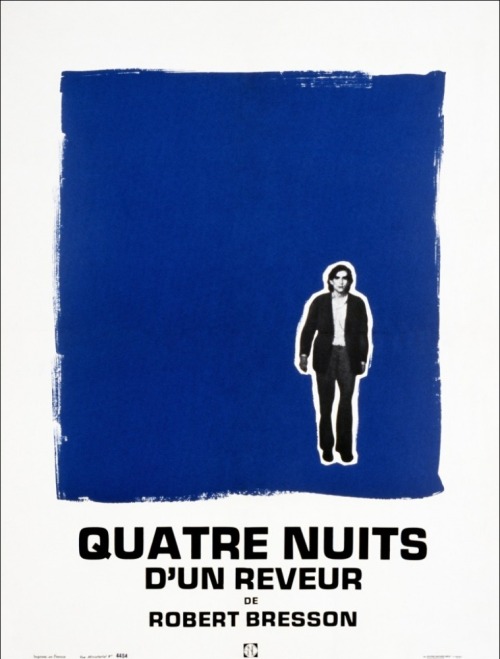
In comparison we looked at Visconti's Le Notti Bianche (1957)and Bresson's Quatre nuits d'un reveur (1971).
I found Visconti's adaptation much more interesting than Bresson's. Set against a background of post-war poverty, Visconti's film subtly reveals his communist convictions, reminding viewers that while the protagonists are caught up in their own drama, people are starving and homeless. The psychological side to Dostoevsky's novella disappears as the story becomes a much more common melodrama. Mario (Marcello Mastroianni) doesn't revel in his own misery like Dostoevsky's (anti)hero; he puts everything on the line to win Natalia (Maria Schell), and is genuinely devastated when it doesn't work out. Interestingly, the script has barely changed from the novella, except that large sections of the narrators monologues are removed and a few scenes are added in (including a spectacular dance scene in a night club). In a way then, Visconti is less progressive than Dostoevsky almost a century earlier.
Another notable aspect of Le notti bianche is its treatment of women. There are three very clear stereotypes in the film: Natalia is the innocent virgin (blonde and doe-eyed), then there is a prostitute scene wandered the city, dark and dangerous, and finally there is Mario's housekeeper in the role of the nagging mother. Fabio argues this is a criticism of heterosexual relationships from Visconti who had to keep his homosexuality quiet - the woman may seem beautiful and appealing at first, but she won't age well and will just nag you death in the end (at this point Fabio turns to me, the only girl in the room, and apologises). This is certainly not an idea present in Dostoevsky's novella, in which Nastenka remains an untouchable ideal.
Robert Bresson's film, by contrast, remains much more faithful to the original, and yet so boring. I am a big fan of French film (as this blog will attest) but 'French' in its derogatory sense (i.e. the worst stereotypes of French cinema) is the most applicable adjective for this film. Our lonely boy this time is Jacques (Guillaume de Foret), an artist, who wanders Paris leering at women (just following them and staring at them for an uncomfortably long time) and recording existentialist musings and pigeon noise in his tape-recorder to play back to himself later. The nature of artistic creation is at the heart of Bresson's adaptation (one of the few sections of dialogue not taken directly from Dostoevsky is a diatribe from a classmate of Jacques about what makes good art), and it is clear that Jacques' interest in Marthe (Isabelle Weingarten) is primarily as a source of inspiration for his paintings. When she leaves him alone again, he goes happily to his canvases to turn the experience into art. Compared to Mario's simple, ardent passion for Natalia in Le notti bianche, this feels like a real let down even though it is far closer to Dostoevsky's original. Proof that fidelity isn't necessary the best quality on which to judge a literary adaptation!
Happy Europe Day! As you may have noticed, I'm a big fan of Europe, especially when it comes to culture, so I actually celebrate Europe Day. The day commemorates the Schuman Declaration of 9 May 1950 in which the then French Foreign Minister Robert Schuman proposed a form of European supranational community, leading to the creation of the European Coal and Steel Community, the ancestor of the EU.
In honour of the day, I'd like to travel through the EU through films, but I'm sad to say I don't know enough. So that's where you come in: please send me your suggestions! I'd love to end up with at least one film for each of the 27 member states.
I'll start off with a few of my favourites. Some of them are obvious choices, famous and critically acclaimed (e.g. La Dolce Vita). Others are less well known, but I love them.
France: Les Chansons d'amour (Love Songs) - Christophe Honoré (2007)
When people think French film, they'd maybe say Godard or Renoir, or more recently films like Amélie or La Haine. I am a huge fan of French cinema, old and new, but there's no director I love more (not just in France but in general) than Christophe Honoré, and his Les Chansons d'amour is my favourite film of all time. Big claim, I know, but I just love it. For starters, it's a musical, which is always going to win my favour, especially as the songs (written by Alex Beaupain) are really catchy. What I love most about it though, is that it explores so many aspects of human relationships, romantic to familial, mundane to illicit, joyful to tragic. It's an engrossing, moving and extremely true-to-life portrayal of love, loss and new beginnings. It also stars some of the best new French talent including Louis Garrel, Chiara Mastroianni and Clotilde Hesme. The trailer does not do it justice (probably because it's trying to avoid giving any plots twists away).
Germany: Metropolis - Fritz Lang (1927)
As much as I love recent German films like The Edukators, The Lives of Others and Goodbye, Lenin!, I'm going old-school for this one. Metropolis is widely regarded as one of the all-time classics and rightly so. It's one of the most creative and iconic films I've ever seen and an incredible technical achievement given when it was made. It proves you don't need words to make drama.
Ireland: Once - John Carney (2007)
A charming little musical made on a shoe-string that has taken the world by storm and has just been taken to Broadway. Staring Glen Hansard (of Irish folk band The Frames) and Czech songwriter Markéta Irglová as musicians who come together to make something beautiful. Their song Falling Slowly won the Oscar for Best Original Song (an honour slightly tarnished by the fact that Man or Mupet won this year). It's also a great film for Europe Day as it shows the benefits of supranational co-operation ;-)
Italy: La Dolce Vita - Federico Fellini (1960)
An obvious choice really. While I enjoy neo-realist classics, smush-fests like Il Postino and Cinema Paradiso, and modern films like Gomorra which show the realities of contemporary Italy, La Dolce Vita encapsulates the glamorous ideal of Rome. Plus I needed Marcello Mastroianni in here somewhere!
The Netherlands: Zwartboek (Black Book) - Paul Verhoeven (2006)
Admittedly I don't know very much about Dutch film at all (please send me recommendations!) but this exploration of Second World War Resistance is really interesting and visually impressive.
Spain: La Mala Educación (Bad Education) - Pedro Almodóvar (2004)
Pedro Almodóvar is undoubtedly the most successful and renowned Spanish film-maker and while All About My Mother is usually cited as his best film, I much prefer Bad Education. This semi-autobiographical film ties together strands that have run throughout his work, including questioning gender and sexuality norms, religious iconography and ambivalence towards the Church, and the nature of film-making. Absolutely beautiful and completely engrossing.
Sweden: Det sjunde inseglet (The Seventh Seal) - Ingmar Bergman (1957)
Another obvious choice, The Seventh Seal is the film that gave the world the iconic image of death playing chess. Beautifully made.
UK: In Bruges - Martin McDonagh
Choosing one film for th UK was always going to be a challenge, so rather than trying to find a film that is particularly representative of Britain, I've just gone with another of my favourite films. It also seems appropriate as it's set in Belgium, home of the EU. I've seen this darkly hilarious gangster film/homage to one of Belguim's biggest tourist attractions so many times and yet it still makes me laugh more than most films.
So that's eight down, only 19 to go! Please send in your suggestions and help me get around the EU in films.
"Salomé, what a woman, what a part, innocent body and a sinful heart!"
- Norma Desmond, Sunset Boulevard
Sunset Boulevard is one of my favourite musicals, so I have been aware of the story of Salomé for a very long time, but until today I had never seen the 1923 film. It turns out that's because few people have. The lovechild of Alla Nazimova, a Russian emigré who found fame on the American stage and screen, and designer Natacha Rambova, who wrote the script under the pseudonym Peter M Winters, the film never really found an audience. Nazimova, known for her flamboyant bisexual lifestyle, reportedly only hired gay or bisexual actors, creating such a scandal that it resulted in the film being shelved. Nazimova was bankrupted and her film production career ended. Now 90 years later, Salomé finally gets its audience, thanks to Charlie Barber, who has composed new music to accompany the film.
Charlie Barber explained at the pre-show talk that he was looking for a film which he could bring to an audience as a fresh experience, rather than something well-known like a Fritz Lang film. His choice of the film was also inspired by the vivid memory of a Lindsay Kemp production of the original Oscar Wilde play which opened with heavy percussion. The new score is based heavily on Arabic rhythms, which Barber says attracted him because of their mathematical quality, and performed with unpitched percussion instruments and voices (a choir singing extracts from the Psalms in Latin, Hebrew and Greek, in keeping with the period, and impressive vocal improvisation from Sianed Jones). Barber didn't want the music to just underscore what we see on screen, but to be a unique experience in itself. Nonetheless, whether as fortuitous as Barber would have us believe or not, the score certainly seems tailored to the action in the film, highlighting the melodrama.
Before the film, Barber warned us that it was going to be extremely camp and he wasn't exaggerating! The men were caked in make-up, jewellery, wigs and nipple-tassels.
Herod especially was shown as a complete buffoon, more of a clown (complete with bright red lips) than the Tetrarch of Judea.
The point of the music then, was to counteract this campfest, with 'serious' rhythms, which keep the audience hooked. I have to say it did a very good job, adding a new layer of depth to the viewing experience, although we still couldn't help laughing at some of the more ridiculous aspects of the film!
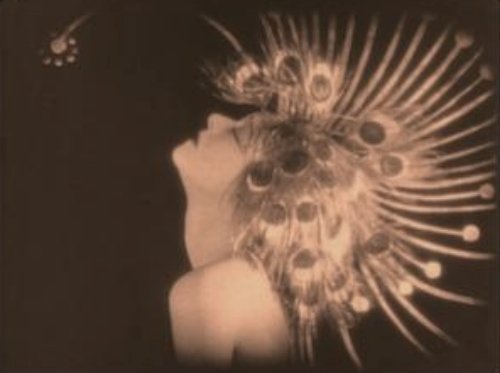
It wasn't all camp though; there were some really beautiful art nouveau pieces, designed by Rambova following illustrations by Aubrey Beardsley. I was particularly struck by Salomé, shot in sepia as she fantasises about being queen among Herod's peacocks.
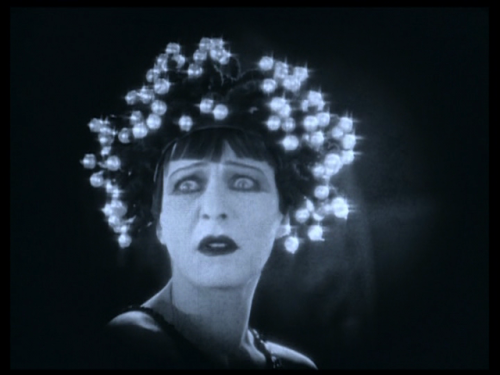
Perhaps the most interesting part of the night for me, though, was finding out just how true to life Sunset Boulevard is. Nazimova - who incidentally lived on Sunset Boulevard - cast herself as the 16 year old Salomé when she was 44 years old, much like Norma Desmond in the film/musical. This was quite off-putting in the film, because even though her body remained remarkably youthful, this is by no means a 16 year old face:
In short, Salomé is definitely worth watching, both for the beautiful art nouveau costumes and to have a good giggle at the camper side of the film. Charlie Barber's music perfectly compliments the on-screen action, and also provides a good focus for attention if you ever drift off of the film. Full details of the tour can be found at www.soundaffairs.co.uk, where you can also buy the soundtrack.
PS: If you have no idea what I'm talking about when I link Sunset Boulevard and Salomé, watch this: