Showing posts with label french. Show all posts

Monday, 4 November 2013

BFI London Film Festival 2013 - As I Lay Dying & Elle s'en va

Every year, the catalogue for BFI's London Film Festival arrives and I get carried away planning the dozens of films I will see, until I'm thwarted by a mixture of selling out (Blue Is The Darkest Colour, Inside Llewyn Davis) or having to be elsewhere (most annoyingly for the one Venezuelan film in the festival, Bad Hair). However, I was happy to still make it to two, very different, films in the first week.

As I Lay Dying

James Franco's adaptation of William Faulkner's 1930 epic depiction of a truly dysfunctional Southern family travelling to bury their mother was one of the main talking points of the festival season. I was particularly looking forward to it as Faulkner, cited as an inspiration for every great Latin American author, is a huge gap in my reading. Most of the controversy around the film stemmed from claims that, as Franco is not from the South, he cannot truly understand Faulkner's source material. While I don't agree with the logic behind that argument at all, having not yet read the book, I can't comment on the fidelity of the adaptation. Nonetheless, I am well aware of the breakdown of narrative certainties created by Faulkner's use of 15 different narrators. I found the use of split screen throughout the film, showing characters from two different angles, or making slightly different actions at once, captured this well, and also made for a very interesting visual experience. I have to admit getting a bit fed up with the unsympathetic characters and how their quest to bury their mother drags on, but, thinking back on it, it seems that the characters themselves would share those feelings, making As I Lay Dying not a film meant to be enjoyed.

Elle s'en va


By contrast, Emmanuelle Bercot's Elle s'en va passed somewhat under the radar, and yet was the film I was most looking forward to, partly because of my enormous love for Catherine Deneuve, but also because the trailer completely won me over. An homage to French cinema's greatest living actress, Elle s'en va is a very touching exploration of the fragility of a former Miss Brittany facing her lost youth and beauty. When her married lover leaves his wife not for her, but for a twentysomething, Bettie leaves her mother and her restaurant behind and begins to drive. The film follows her odyssey through the French countryside, from random encounters in dive bars, through painful memories, to possibilities of renewal. Bercot deftly balances fear and hope, sorrow and humour, without ever falling in to cliché. However, the main attraction of course is Deneuve's tour de force performance: she is an absolute joy to watch, and proves that 70 can be sexy.

Sunday, 26 May 2013

The Spectacular Translation Machine

At the King's Cultural Institute Creative Labs on Thursday I had the pleasure of meeting Dr Ricarda Vidal who does all sorts of exciting things with translation, such as the upcoming Translation Games. Thanks to her, I found out about The Spectacular Translation Machine event at the Southbank Centre's London Literature Festival this weekend, which as a language nerd I would have been really sad to miss out on.


Translation can be a lonely activity, with nothing but you, your source text and a pile of dictionaries. The Spectacular Translation Machine aims to change that. For one weekend, members of the public - from French native speakers to absolute beginners - will collectively translate an entire French book into English, under the guidance of experts lead by award-winning translator Sarah Ardizzone. The book in question is On les aura!, a graphic novel with a fascinating story behind it. On les aura! began life as the diary of a soldier fighting in the first few months of World War I. The soldier is never named, and what happens after the diary ends remains unknown. French illustrator Barroux recently found the diary and decided to publish the text verbatim accompanied with his distinctive line drawings (Paris, Seuil: 2011). The project is therefore a double first: the first time ever that a book will have been translated collaboratively over one weekend, and the first translation of this work into English.


The space in the Royal Festival Hall allocated to the project felt like a magical translation playground, designed to make translation as engaging and interactive as possible. Large whiteboards on the walls were covered in alternatives for the title, for visitors to add to, and the table was littered with not only a range of dictionaries, but maps, reference books and other items to get people into the frame of mind of a French WWI soldier. A washing line was strung across the whole room with each panel of the graphic novel pegged up. Visitors could choose which of the panels they would like to work on, write their own translation and then peg it up with other people's versions. Participants are encouraged to discuss their translation attempts with each other, creating a real sense of community, as everyone seems so passionate about language and literature. At the end of the weekend, the experts will put all of the panels together into a complete book. What I love most about the project is that its truly collaborative nature will ensure the best possible translation of the book. Because translations are often individual efforts, the end result is naturally a subjective interpretation of the original; for as much as translators try to stay faithful to the source text, they cannot avoid making choices between different words or ways of interpreting a phrase. 

Another reason why this project is so exciting is the opportunities it opens up for translating texts quickly, accurately, and most importantly in today's market, cheaply. The chronic under-representation of foreign fiction in British markets is undoubtedly due in large part to the unwillingness of publishers to finance translations. Turning the activity of translation into an event not only reduces these costs but creates invaluable publicity for the finished product. While this event is thanks to the British Centre of Literary Translation, I really hope that publishers take note and run events like this of their own in the future, not only for the fun of being part of a community activity, but to help other wonderful books from other languages achieve the translation they so desperately need if they want to find an audience outside their country of origin. 

My attempt at translating one of the first panels from On les aura!
Translation continues at the Royal Festival Hall on Sunday 26, Monday 27 May. and Saturday 1 June. The results will then be presented in a celebration on Sunday 2 June at 3pm. Full details are available here.

Wednesday, 11 April 2012

Marguerite and French collaboration

Having spent the best part of today researching for an essay on the French far right, including reading about Vichy collaboration (I highly recommend Jim Shield's very readable introduction The Extreme Right in France), I keep thinking about how I first came to learn about the events of that time. It wasn't from a textbook, but from a musical: Marguerite.


I was drawn to Marguerite for many reasons:
  •  As Ruthie Henshall went to my school (long before me of course!), we were inculcated into following her career from a young age, so I couldn't miss such a vehicle for her.
  • Julian Ovenden, as Marguerite's love interest Armand, has, in my opinion, the best voice on the West End stage.
  •  It's written by Alain Boublil and Claude-Michel Schönberg, the incredibly talented team behind Les Misérables, Miss Saigon and Martin Guerre, all of which I absolutely love.
All of the above in part explain why it's now one of my favourite - and certainly most listened to - musicals, but the real reason I can't get enough of it is because its such a powerful history lesson.  

On one level, Marguerite is another version of Alexandre Dumas' La Dame aux camélias, a story retold again and again, from La Traviata to Moulin Rouge: a courtesan falls for a romantic young  man who gives her a second chance for love and freedom, but must give him up to save his life, and a tragic ending ensues. But a Boublil and Schönberg musical is never just a romance, and just as Miss Saigon brought aspects of the Vietnam war that had been swept under the carpet to the stage, so Marguerite does not shy away from perhaps the most difficult part of French history.

The musical starts in 1940. Marguerite is French and her keeper, Otto, a leader of the German occupation. Their relationship mirrors that of France and Germany: "Great Germany, supreme in power, and France in beauty, side by side". At the same time Marguerite's naive, frivolous relationship with her young suitor Armand juxtaposes the plight of Armand's sister Annette and her Jewish fiancé Lucien, who must live in constant fear as the French are going well beyond the demands of the Nazi occupiers in rounding up, deporting and torturing Jews. 


Marguerite certainly doesn't pull any punches when it comes to the portrayal of the French bourgeoisie. Sure of Germany's eventual victory, they are shown profiteering, handing over Jews, and praising the German's for 'cleaning up France'. Then as soon as it's clear the Allies are going to win, they happily change sides and start searching for scapegoats. Having only ever learnt about the brave, French Resistance before, it was fascinating to see how people exploited the myth of Resistance for their own self preservation (of course lots of people did genuinely resist, but the real numbers are tiny compared to those who say they did).

  
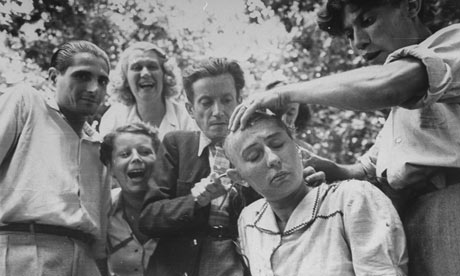
Perhaps most shocking is the way Marguerite was treated. While she herself actually helps the resistance, she is an obvious target, a visible 'traitor' as everyone has seen her with a German man. She is subjected to a public humiliation and head-shaving to forever mark her as a collaborator, a practice sadly common at a time when everyone was trying to prove their innocence by piling blame onto an easy target.


Musicals are too often dismissed as light and fluffy - and some of them most certainly are - but Marguerite is undoubtedly a musical for grown-ups. Beyond the wonderful music and story-telling that Boublil and Schönberg are famous for, Marguerite is a fascinating insight into a period that too many people would rather ignore.

Friday, 13 January 2012

Don Juan, Blue of Noon and intertextuality

Having watched the Don Juan Triumphant scene from The Phantom of the Opera over and over (I got the 25th anniversary concert for Christmas and the overwhelming passion in that scene just gets to me, especially the way Ramin Karimloo and Sierra Borgess play it, but anyway...), I remembered my cultural mobility class and started thinking about how many different ways the Don Juan myth has been adapted and appropriated over the centuries. What better example of adaptation and appropriation creating cultural bonds in Europe than a pastiche of an opera written in Italian (Don Giovanni, with lyrics by Lorenzo Da Ponte) composed by an Austrian (or Holy Roman Empire-an really... Mozart of course) based on a Spanish source text (El burlador de Sevilla y convidado de piedra by Tirso de Molina), within an English musical based on a French novel (Gaston Leroux's Le Fantôme de l'Opéra)?


Once I got over just how many countries are linked in that one scene, I started reading the list of works which are, to varying degrees, reworkings Don Juan. There are loads, but one in particular jumped out at me, Georges Bataille's 1935 novel Le Bleu du ciel (Blue of Noon). "Wow, that'd be interesting" I thought. Interesting is the right word. Pleasant, however, certainly isn't. Given that I came to know of Bataille through Christophe Honoré's film adaptation of his novel Ma Mere, a shockingly graphic study of incest, I should have known what to expect from Blue of Noon really.


Our Don Juan in this story is Henri Troppman who is interminably drunk, depressed and depraved. While Don Giovanni famously had 'mil e tre' women in Spain (not to mention all the others around the Europe), we're not sure how many prostitutes Henri has been with exactly, but it's clearly a lot. What we do know is that the women in his life are currently the filthy rich and just plain filthy Dirty (or Dorothea), the disgustingly ugly Marxist revolutionary Lazare (based on Simone Veil), the somewhat naive Xenie, and briefly a German tourists, as well as an ex-wife who we never see, a mother-in-law who acts as housekeeper/guardian and the constant spectre of his mother lurking in his unconscious (returning to the subject matter of Ma Mere). Troppman isn't much of a lothario though - he finds himself impotent with Dirty, has Xenie play his nursemaid when he believes himself on death's door, and uses Lazare as someone to confess his sins to. In fact there's little to suggest this is an appropriation of Don Juan except for frequent references to il Commendatore, but it is those references that make all the difference.

The informed reader will recognise the character of il Commendatore as Don Juan's victim who comes back from beyond the grave to dine with our anti-hero and force him to repent or be dragged down to hell. Thus by mentioning il Commendatore, Troppman reveals that he thinks he should be made to repent for his depraved behaviour, that he senses impending doom. Given that the novel was written in 1938, and explicitly mentions the foreboding sense of war approaching, the images of hell and eternal suffering that il Commendatore conjures up seem very appropriate. Perhaps more interestingly, we can infer that this character is extremely narcissistic, as he wishes to equate himself with the greatest seducer in history, when his actions seem to pale in comparison with the 'trickster of Seville'. This certainly seems in keeping with a character who spends most of his time moping and thinking about his own death, but implicitly adds a new layer of depth to him.

Julie Sanders argues in Adaptation and Appropriation that part of the pleasure of reading comes from playing detective and piecing together the extra meaning provided by the intertexts (or bits of a text borrowed from/inspired by/reacting to other texts). That's certainly true of Blue of Noon - whilst I spent most of the book thinking "This is horrible, why am I reading this?", the Don Juan connection turned the chronicle of a man with unconventional sexual tastes and an unquenchable thirst for champagne and histrionics into a much more engaging story.

Friday, 23 December 2011

Why I love Mozart l'Opéra Rock

If you're not French, you probably won't have heard of Mozart, l'Opéra Rock. If you are French, it would have been difficult for you to avoid it, given that it's toured up and down the country, the songs have been in the charts and even sung on the French versions of X Factor. The stars have become pop idols, unusually for musical theatre performers. Mozart is making musicals - and opera - cool (at least in France).


I first saw the show shortly after arriving in Paris and my French was nowhere near good enough to follow the dialogue and the lyrics but I was still totally engrossed in the music. It's a mixture of Mozart's own music, traditional musical fare from emotional ballads to rousing party scenes and more rocky music. It sounds strange, but it works perfectly. I also absolutely loved the costumes, an emo take on 18th century chic!


Over two years later, my French has significantly improved and I have listened to the show countless times, so I now appreciate the story as much as the music. It seems that Mozart not only had an incredible musical talent, but also a life that lends itself to drama. The musical chronicles his thwarted infatuation with gold-digging singer Aloysia Weber to finding true love with her sister Constance; the overwhelming presence of his father; his travels from Salzberg to Mannheim, Paris and finally Vienna, causing mischief and searching for fame; and of course his rivalry with Antonio Salieri and untimely death.


One of the main reasons that I love the show is it's a really great way to learn French. The songs are so catchy you can't get them out of your head and unless you want to walk around singing 'la la la' you will end up looking up the lyrics and searching for the meanings in dictionaries. At least that's what I did and learnt countless words that way. Much more fun than a text-book!

However, if you want to cheat, someone has kindly uploaded the show with English subtitles to YouTube: