Showing posts with label adaptation. Show all posts

Sunday, 29 July 2012

The White Nights - from Dostoevsky to Visconti + Bresson

Writing about Notes from Underground just now made me realise I never finished and published this post from way back in January. Here it is only half a year late.

Classes have started again, whoo! It may be incredibly geeky but my life seems a bit lacking in purpose without learning to do. And as I'm paying so much for this education, I might as well share it with you.

The first course to begin is called Crossing Borders: Adaptation from Literature to Film, which brings together a whole load of things I love, and the first adaptation we're looking at is The White Nights (full text available here).


The White Nights is a short story by Dostoevsky (1848) telling the story of a dreamer and the four nights he spends with an impossible love. This story has often been written off as just a minor Dostoevsky novella, nothing more than a romance. But my teacher, Fabio Vighi, argues that it's much more than that. This is the turning point for Dostoevsky, the moment when he moved from radically political texts to complex psychological ones, anticipating Freud's theory of the unconscious and the split-subject and thus creating the modern anti-hero far before the modern period itself. How do we get all that from a fifty page novella? In fact, it's just from a few lines here and there, lines you may well pay no attention to if you're not looking for them, but those few lines have an incredible depth of meaning. It's the story of a nameless young dreamer who is a bit of an outsider, but seemingly happy in his misery. One night he meets a crying woman, Nastenka, and falls for her over the three consecutive nights until her wayward lover returns. He is sad, of course, but happy to be sad as it gives him a life experience that makes him special.

In comparison we looked at Visconti's Le Notti Bianche (1957) and Bresson's Quatre nuits d'un reveur (1971).


I found Visconti's adaptation much more interesting than Bresson's. Set against a background of post-war poverty, Visconti's film subtly reveals his communist convictions, reminding viewers that while the protagonists are caught up in their own drama, people are starving and homeless. The psychological side to Dostoevsky's novella disappears as the story becomes a much more common melodrama. Mario (Marcello Mastroianni) doesn't revel in his own misery like Dostoevsky's (anti)hero; he puts everything on the line to win Natalia (Maria Schell), and is genuinely devastated when it doesn't work out. Interestingly, the script has barely changed from the novella, except that large sections of the narrators monologues are removed and a few scenes are added in (including a spectacular dance scene in a night club). In a way then, Visconti is less progressive than Dostoevsky almost a century earlier.

Another notable aspect of Le notti bianche is its treatment of women. There are three very clear stereotypes in the film: Natalia is the innocent virgin (blonde and doe-eyed), then there is a prostitute scene wandered the city, dark and dangerous, and finally there is Mario's housekeeper in the role of the nagging mother. Fabio argues this is a  criticism of heterosexual relationships from Visconti who had to keep his homosexuality quiet - the woman may seem beautiful and appealing at first, but she won't age well and will just nag you death in the end (at this point Fabio turns to me, the only girl in the room, and apologises). This is certainly not an idea present in Dostoevsky's novella, in which Nastenka remains an untouchable ideal.
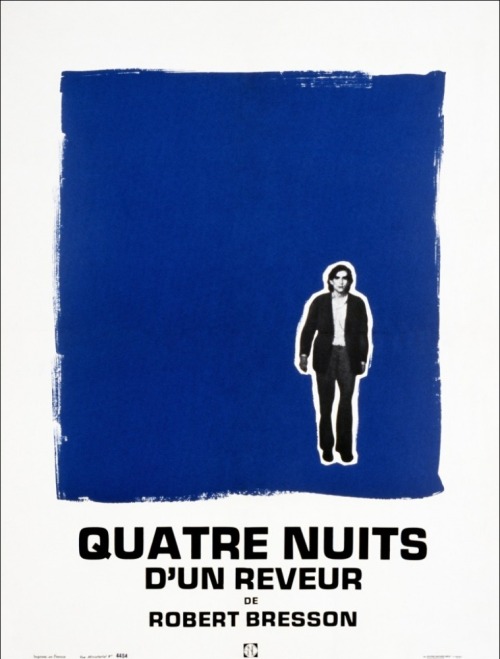

Robert Bresson's film, by contrast, remains much more faithful to the original, and yet so boring. I am a big fan of French film (as this blog will attest) but 'French' in its derogatory sense (i.e. the worst stereotypes of French cinema) is the most applicable adjective for this film. Our lonely boy this time is Jacques (Guillaume de Foret), an artist, who wanders Paris leering at women (just following them and staring at them for an uncomfortably long time) and recording existentialist musings and pigeon noise in his tape-recorder to play back to himself later. The nature of artistic creation is at the heart of Bresson's adaptation (one of the few sections of dialogue not taken directly from Dostoevsky is a diatribe from a classmate of Jacques about what makes good art), and it is clear that Jacques' interest in Marthe (Isabelle Weingarten) is primarily as a source of inspiration for his paintings. When she leaves him alone again, he goes happily to his canvases to turn the experience into art. Compared to Mario's simple, ardent passion for Natalia in Le notti bianche, this feels like a real let down even though it is far closer to Dostoevsky's original. Proof that fidelity isn't necessary the best quality on which to judge a literary adaptation! 

Tuesday, 3 April 2012

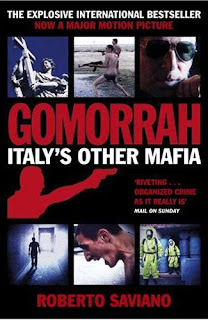
Gomorrah: the Neapolitan Mafia from page to screen

As I've not had so much to review this week, I think it's time to go back to sharing what I've been doing in class with you. In my final classes of my MA (I can't believe it's almost over already), we've been looking at Gomorrah, Roberto Saviano's denunciation of the Camorra, the Campania version of the Mafia, which became an instant hit while condemning Saviano to a life-time in hiding.


This interview with Saviano on The Culture Show (the BBC's, not mine sadly!) really highlights what a sacrifice it was for Saviano to write Gomorrah.


Our study of Gomorrah was the final part of the course on adaptation of literature to film. Gomorrah made a particularly interesting case study because when I first read it, I thought it would be absolutely impossible to turn into a film. To highlight the enormous scale of the Camorra, its all-pervasive power within Naples and the surrounding areas, and its infiltration of Italian politics and global business, the book is bursting with lists, numbers, names and facts. This has a really powerful effect but lists obviously don't work well on screen. Moreover, the aim of the book, and the film, was to counteract the glamorising of the Mafia by Hollywood films, so rather than graphic murders, we have to see the day-to-day, the slums, the toxic waste, and the constant counting of dirty money.

The adaptation cleverly turned the huge cast of characters from the book into a few protagonists who embodied the main themes of Saviano's work. While this made a more watchable film (although as Mark Kermode points out, it's still a difficult watch because there really is no-one to root for), the film had to get creative to still give a sense of the scale of the Camorra. In particular, the scenes of the slums were full of visual metaphors for the Camorra's activity and its effect on people's lives.

The scenes in the Neapolitan mass social-housing make clear just how trapped the local people are. They are constantly shown behind bars which foreshadow the prisons that many of them will end up in if they're not killed first. The use of light and dark is particularly effective, as it's always bright outside, suggesting freedom and a better future, but the people in the slums are stuck in the shadows.


In these shadows we often can't see people's faces - we know they're doing some 'shady' deals but its not clear what, just like the Camorra's business activities. This is enhanced in the film by the sound of shouting - we cannot work out what is being said but we know it's angry.


The sound and lighting creates a sense of the 'everyman', as in everyone is involved in the Camorra in one way or another. This is a key element of the book which stresses how the Camorra 'democratised' the drug trade, allowing everyone to become a dealer, even if just to a small group of friends. This point is highlighted in the brief shot of the open air drug market, where heads cannot be seen (notice the bars once again). The scene is shot from above through a child's perspective, suggesting a strong moral judgement on these activities.


We see another slum which is the same but different, suggesting the scale of the deprivation in the area, and how nothing ever changes. The tight central corridor exemplifies the lack of escape options for the residents, as there is no other way out. The slum works as a panopticon: everyone's behaviour is constantly under scrutiny, so people have no choice but to act in the way expected, in this case following the Camorra.


Finally, we see the huge scale of the housing estate which brings home just how wide-spread the problem of the Camorra is. This housing estate might once have been bright white and modern, but it has been ignored and left to decay ever since. This is emblematic of the way the people of Campania see their situation in relation to the official authorities. The government don't care about their struggles so they have to turn to the Camorra for protection and for economic growth. The small area of colour where the children play may at first suggest innocence and a brighter future, but the juxtaposition with the rest of the grey housing estate, and the Camorra guards on duty just above them remind us that their childhood will end quickly and their future is bleak.


Thursday, 23 February 2012

Extremely Loud & Incredibly Close

Extremely Loud & Incredibly Close will surely have come to your attention for being nominated for a Best Picture Oscar before even having a cinematic release, but it also fits nicely into my current studies of literature to film adaptation, in obvious and surprising ways.


The film, directed by Stephen Daldry and adapted by Eric Roth from Jonathan Safran Foer's iconic 2005 novel, has been almost universally panned. It has a 45% approval rating on Rotten Tomatoes and The Guardian even asked whether it was the worst Best Picture nomination ever. I think this harsh criticism is at least in part inspired by the Oscar nod: if it were not up for the award, I doubt people would have reacted with such vitriol, but rather indifference. After all, judged on its own merits, it's alright. I was very ready to hate it after seeing the trailer - and knowing the book - but it was fine. Yes it's shmaltzy, over-sentimental and contrived but I didn't have an urge to give up on it at any point during the two-and-a-bit hours, I very much liked Max von Sydow and I thought Oskar's meetings with the various Blacks were well executed.

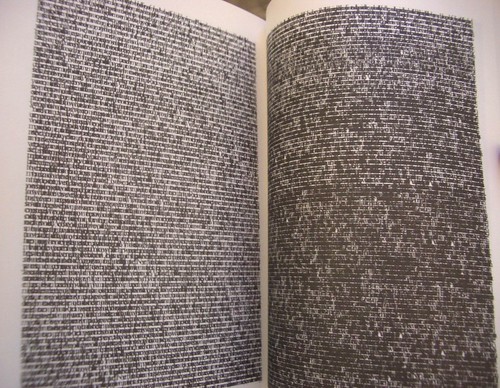
However, I absolutely loved the book. I read it all in about 8 hours, not wanting to put it down. Adapting Extremely Loud... was always going to be a very difficult part, as much of its magic relies on how it is put on paper. The book is a mixture of Oskar's streams of consciousness, letters he writes and receives, letters his family write, photographs, newspaper clippings, things his mute grandfather writes in his daybooks to communicate with people, and even tester papers from a stationary store. As you can see below, the layout of the book tries to imitate the way the characters write (in this case the grandfather trying to fit as many words as possible on his rapidly dwindling paper - part of the fun is trying to read these palimpsests). The film was never going to be able to recreate this, but the annoying thing is that it didn't even try to create a similar feeling with innovative filming or montage techniques, instead giving us a very mundane film.


The worst sin of the film-makers though, in my opinion, was the complete sanitation and Hollywoodising of the story. What really caught my attention in the novel was how Oskar's grandparents' lives were changed forever by the bombing in Dresden. By almost completely ignoring this crucial part of the story, the film-makers have not only removed a very relevant comparison with Oskar's current situation (perhaps in was thought that 9/11 is incomparable?) but also gave me the impression that they believed it wasn't proper to consider the suffering of Germans at the hands of the Allies. This is, after all, an extremely patriotic film. Scenes at the Twin Towers have been added in and there is much more focus on the courage of those there. I'm not saying this is a bad thing, it just doesn't leave much room for considering that others have suffered too.

It's not just the Dresden bombings that were erased, but the complex adult relationships. In the book, Oskar is angry that his mother is spending time with another man, but in the film Sandra Bullock remains a devoted, grieving widow. I got the impression that the film-makers thought it wasn't appropriate for her to move on so quickly, or even to seek solace with company. Yet it is the relationship between Oskar's grandparents that is most sorely missed. The delicate balance of remembering and forgetting, supporting each other and causing each other pain was for me the most captivating part of the book, a sensitive examination of a very real relationship. I was very disappointed to see it gone. Moreover, much criticism of both the film and the novel has been that the young protagonist Oskar is 'extremely pretentious and incredibly irritating', which I agree with, but in the book it's not so much of a problem as there are lots of other characters who are far more engaging. In the film, on the other hand, it's all on Oskar and he does grate on you. However, while it would have been very easy to put a man in with Oskar's mother, doing justice to the complexities of Oskar's grandparents would have required much more time than this already long film could offer, so maybe I should just accept that the film could never have been a full recreation of the book, and take it for what it is? After all, we're always told in class not to reduce the question to 'The book is better and that's that', but to look at what we can learn from how the film has been adapted. In this case, I think we can mainly learn a lot about attitudes to 9/11.

Talking of class, I was very surprised to find a link between Extremely Loud... and the latest of my course books, Gunter Grass' The Tin Drum. I read Extremely Loud... only a few weeks before The Tin Drum but the obvious intertextuality didn't occur to me until I stumbled across an article called The Extremely Loud Tin Drum. Then suddenly it was so clear: two Oskars, one with a drum, the other with a tambourine, both finding comfort in their grandmothers... The filmic Oskar Schell even had a striking resemblance to Oskar Matzerath, with the piercing Bronski blue eyes.


I take this as a clue to the intentions behind Extremely Loud... The Tin Drum became known as the great novel of the twentieth century for its vivid and over-arching descriptions of the rise of Nazism, WWII and ensuing capitalist era. Although on a much smaller scale, Extremely Loud... aims to continue this portrayal of major world events through the eyes of a child, from WWII to 9/11, focusing on the devastating personal consequences. If only Oskar Schell had been half as complex, witty and engaging as Oskar Matzerath.