Classes have started again, whoo! It may be incredibly geeky but my life seems a bit lacking in purpose without learning to do. And as I'm paying so much for this education, I might as well share it with you.
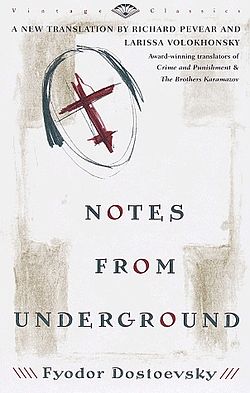
The first course to begin is called Crossing Borders: Adaptation from Literature to Film, which brings together a whole load of things I love, and the first adaptation we're looking at is The White Nights (full text available here).

The White Nights is a short story by Dostoevsky (1848) telling the story of a dreamer and the four nights he spends with an impossible love. This story has often been written off as just a minor Dostoevsky novella, nothing more than a romance. But my teacher, Fabio Vighi, argues that it's much more than that. This is the turning point for Dostoevsky, the moment when he moved from radically political texts to complex psychological ones, anticipating Freud's theory of the unconscious and the split-subject and thus creating the modern anti-hero far before the modern period itself. How do we get all that from a fifty page novella? In fact, it's just from a few lines here and there, lines you may well pay no attention to if you're not looking for them, but those few lines have an incredible depth of meaning. It's the story of a nameless young dreamer who is a bit of an outsider, but seemingly happy in his misery. One night he meets a crying woman, Nastenka, and falls for her over the three consecutive nights until her wayward lover returns. He is sad, of course, but happy to be sad as it gives him a life experience that makes him special.
In comparison we looked at Visconti's Le Notti Bianche (1957) and Bresson's Quatre nuits d'un reveur (1971).

I found Visconti's adaptation much more interesting than Bresson's. Set against a background of post-war poverty, Visconti's film subtly reveals his communist convictions, reminding viewers that while the protagonists are caught up in their own drama, people are starving and homeless. The psychological side to Dostoevsky's novella disappears as the story becomes a much more common melodrama. Mario (Marcello Mastroianni) doesn't revel in his own misery like Dostoevsky's (anti)hero; he puts everything on the line to win Natalia (Maria Schell), and is genuinely devastated when it doesn't work out. Interestingly, the script has barely changed from the novella, except that large sections of the narrators monologues are removed and a few scenes are added in (including a spectacular dance scene in a night club). In a way then, Visconti is less progressive than Dostoevsky almost a century earlier.
Another notable aspect of Le notti bianche is its treatment of women. There are three very clear stereotypes in the film: Natalia is the innocent virgin (blonde and doe-eyed), then there is a prostitute scene wandered the city, dark and dangerous, and finally there is Mario's housekeeper in the role of the nagging mother. Fabio argues this is a criticism of heterosexual relationships from Visconti who had to keep his homosexuality quiet - the woman may seem beautiful and appealing at first, but she won't age well and will just nag you death in the end (at this point Fabio turns to me, the only girl in the room, and apologises). This is certainly not an idea present in Dostoevsky's novella, in which Nastenka remains an untouchable ideal.
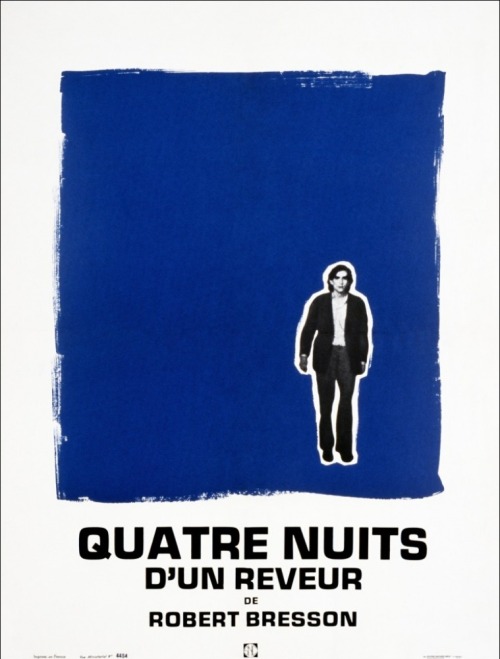
Robert Bresson's film, by contrast, remains much more faithful to the original, and yet so boring. I am a big fan of French film (as this blog will attest) but 'French' in its derogatory sense (i.e. the worst stereotypes of French cinema) is the most applicable adjective for this film. Our lonely boy this time is Jacques (Guillaume de Foret), an artist, who wanders Paris leering at women (just following them and staring at them for an uncomfortably long time) and recording existentialist musings and pigeon noise in his tape-recorder to play back to himself later. The nature of artistic creation is at the heart of Bresson's adaptation (one of the few sections of dialogue not taken directly from Dostoevsky is a diatribe from a classmate of Jacques about what makes good art), and it is clear that Jacques' interest in Marthe (Isabelle Weingarten) is primarily as a source of inspiration for his paintings. When she leaves him alone again, he goes happily to his canvases to turn the experience into art. Compared to Mario's simple, ardent passion for Natalia in Le notti bianche, this feels like a real let down even though it is far closer to Dostoevsky's original. Proof that fidelity isn't necessary the best quality on which to judge a literary adaptation!