Showing posts with label collaboration. Show all posts

Tuesday, 1 August 2017

On Collaborative Research and Writing


Like so many PhD students these days, I did many other projects while I was "writing my thesis". A mixture of trying to avoid the isolation that plagues doctoral study, insatiable curiosity and an inability to focus on a sole project for too long lead me to take any collaborative opportunity which came my way. The longest running of these was the "How to Get an Academic Job" project, which I joined as a bright-eyed, naive first year PhD. As our article based on the project has recently been published, now seems like a good time to reflect on the whole process.

Back in late 2012, Dr Anna Mountford-Zimdars - Senior Lecturer at King's Learning Institute, specialising in access to Higher Education and employment - put out a call through the Graduate School for PhD students to participate in a project on academic hiring, which would involve interviewing academics from our discipline. She ended up with 12 researchers from different arts, humanities and social science disciplines, as well as two international students (from Italy and Korea) who provided an insight into academic life and hiring in their home countries. Over the course of the academic year, we worked collaboratively to develop research questions, carry out the study and analyse the results. The first stage was a meeting with Anna and Charles, our learning technologist, which began with a discussion about what we, the student-researchers, wanted to get out of the project. This was a decisive moment: while Anna had planned a project on academic hiring - what do junior academics think helped them to get their jobs, what do senior academics look for when they are on hiring panels - it soon became clear that as student-researchers we were concerned about whether we should be trying for an academic job in the first place. Is it worth it? The interview plan thus developed to include questions about what academic life is like day-to-day, what academics value about it and what they dislike, alongside the questions about career histories. When the time came to analyse the results, the most interesting findings in my mind came from the interplay between these two areas. Of particular note was the fact that many academics gave human interaction - above all nurturing students - as what they valued most about the job, and yet it was one of the least recognised factors in academic hiring.

The research itself involved each of us interviewing two academics in our field - a new hire and a professor or head of department. In the article we eventually published, we recommended more dialogue between graduate students and staff about career trajectories, as the real life stories are often quite different to the image created by just looking as person specs or job adverts. Some participants also noted that it made high-up academics seem much more human to them, perhaps opening a path for more collaboration across career stages. To carry out the interviews, we were all given training on qualitative research methods and ethics, entirely new to some of us.

After our first interviews, we posted recordings and our preliminary thoughts on a private online discussion forum. We were paired up so that researchers from different disciplines listened to each other's interviews (I learnt about Management) and also wrote down our thoughts on them. This both allowed reflection on similarities and differences between subjects, and established closer relationships between members of the team. When we met up to discuss findings and next steps, all of this was celebrated with cake, a much needed part of any project.

After this meeting, we set up a working group to process the data. Between five of us, we produced materials including top tips, case studies and visualisations, used in a leaflet for students, a website and on a poster presented at a teaching and learning conference at King's. 

The final stage was just Anna and me. This is where the real collaborative work began. Rather than each working on separate sections, we worked together to write first a presentation for a Higher Education Academy conference on student transitions, and then the aforementioned article. Over tea, pizza, and more cake, we discussed the shape of the paper, what was important to include, and how to respond to the reviewers' suggestions. Anna brought expert knowledge of the discipline, I brought my linguist's eye for the nuances in words used in interviews, and for crafting a story out of data. Such collaborative writing seems to be the done thing in Education, it is much less common in languages (although notable recent examples include this paper on Modern Languages and Digital Humanities by Claire Taylor and Thea Pitman. I'm hoping to continue writing collaboratively if any volunteers are reading! 

Ironically, I'm pretty certain the article did not help me to get an academic job. The academics we interviewed offered a wide range of factors they look for when hiring - including enthusiasm for the discipline and collegiality - but, as to be expected, publications came out on top. And publications means publications in your discipline which can be submitted to the REF- as recent job interviews have confirmed - not an education article. But the skills I learned from it, the intellectually challenging experience, and the social aspects have strengthened me as a researcher and will no doubt influence my future work.

Thursday, 17 December 2015

Connections, collaboration, and communication: what I learnt from the LAHP Languages and Policy Workshop

On Monday 7 December 2015, I attended a workshop on languages and policy hosted by the London Arts and Humanities Partnership. Having worked for The Policy Institute at King’s while completing my PhD on literature and cultural policy in Venezuela, I was very keen to learn more about how languages – or, more broadly, language-based area studies – interact with policy. This thought-provoking workshop highlighted three areas of interest: how policy affects the study of languages, the intersection of languages and policy outside of academia, and how aspects of language-based academic research can link to policy. For me, the workshop can be summarized in three linked key terms: connections, collaboration, and communication.

From Jocelyn Wyburd’s facts and figures about the crisis in languages education, particularly the deficit of secondary school language teachers, it was clear to me that we need to work together across the languages to lobby the government and encourage the study of languages. To do this, we must also reach out to other disciplines, such as neuroscience to show the cognitive benefits of language learning, or social scientists to discuss multilingualism and social cohesion. Philip Cavendish from the School of Slavonic and Eastern European Studies at UCL gave an example of a department which combines traditional language-related research (study of a language and its related culture) with subjects including politics and international relations, while also working with institutions beyond the university (the FCO, Open Democracy, the Calvert Foundation). I found it a shame, however, that there is not much communication between SSEES and other languages departments. I strongly believe that scholars in different languages have a lot to gain from working together; not only the traditionally taught European languages, but also the Asian and African languages which are often limited to specialist institutions such as SOAS.

In the second session, Chris Murray (Institute for Public Policy Research), Helen Laker (Southwark Council), Carolina Gottardo (Latin American Women’s Rights Service) and Lucila Granada (Coalition of Latin Americans) all demonstrated the interplay between languages and policy in the real world, in sectors such as education, health care, housing and employment. What struck me most was that all four depend on volunteers. While it was suggested that volunteering could be considered as an internship for PhD students, I thought that as undergraduate students often complain that they do not get enough speaking practice, why not put them in contact with associations or charities? I would like to explore further how to integrate this useful language practice into the undergraduate degree.

The final session stressed the importance of putting yourself out there, meeting people, making connections and being prepared to go beyond your comfort zone. I noted that Hilary Footitt called her work on the language policies of NGOs ‘a strange project to have arrived at’, and I paraphrased Ben Schofield with ‘If someone offers you something weird and wonderful, go for it’. The panel encouraged us to think creatively about links between our research of obscure literature (in both Ben’s and my case at least!) and wider policy implications. They suggested going to conferences on subjects outside of our own to find links, as Hilary did, both with other disciplines and other institutions. From lobbyist Zacahary Bishop, I learnt to develop my USP/‘elevator pitch’, so that if I’m ever in a room with policy-makers they can tell straight away if there is an opportunity for collaboration. Finally, Ben (who is something of a Twitter personality: @haben_und_soll), reminded us that social media is a useful tool: we should let the world know what we’re doing so people can find us!


Given the focus on connections, communication and collaboration, it was great to have not only speakers but other attendees from a wide range of disciplines, including sign language, education and medical humanities. We definitely learnt a lot from each other, and left inspired to build more connections beyond our own disciplines.

For more information about the LAHP, visit www.lahp.ac.uk

Sunday, 26 May 2013

The Spectacular Translation Machine

At the King's Cultural Institute Creative Labs on Thursday I had the pleasure of meeting Dr Ricarda Vidal who does all sorts of exciting things with translation, such as the upcoming Translation Games. Thanks to her, I found out about The Spectacular Translation Machine event at the Southbank Centre's London Literature Festival this weekend, which as a language nerd I would have been really sad to miss out on.


Translation can be a lonely activity, with nothing but you, your source text and a pile of dictionaries. The Spectacular Translation Machine aims to change that. For one weekend, members of the public - from French native speakers to absolute beginners - will collectively translate an entire French book into English, under the guidance of experts lead by award-winning translator Sarah Ardizzone. The book in question is On les aura!, a graphic novel with a fascinating story behind it. On les aura! began life as the diary of a soldier fighting in the first few months of World War I. The soldier is never named, and what happens after the diary ends remains unknown. French illustrator Barroux recently found the diary and decided to publish the text verbatim accompanied with his distinctive line drawings (Paris, Seuil: 2011). The project is therefore a double first: the first time ever that a book will have been translated collaboratively over one weekend, and the first translation of this work into English.


The space in the Royal Festival Hall allocated to the project felt like a magical translation playground, designed to make translation as engaging and interactive as possible. Large whiteboards on the walls were covered in alternatives for the title, for visitors to add to, and the table was littered with not only a range of dictionaries, but maps, reference books and other items to get people into the frame of mind of a French WWI soldier. A washing line was strung across the whole room with each panel of the graphic novel pegged up. Visitors could choose which of the panels they would like to work on, write their own translation and then peg it up with other people's versions. Participants are encouraged to discuss their translation attempts with each other, creating a real sense of community, as everyone seems so passionate about language and literature. At the end of the weekend, the experts will put all of the panels together into a complete book. What I love most about the project is that its truly collaborative nature will ensure the best possible translation of the book. Because translations are often individual efforts, the end result is naturally a subjective interpretation of the original; for as much as translators try to stay faithful to the source text, they cannot avoid making choices between different words or ways of interpreting a phrase. 

Another reason why this project is so exciting is the opportunities it opens up for translating texts quickly, accurately, and most importantly in today's market, cheaply. The chronic under-representation of foreign fiction in British markets is undoubtedly due in large part to the unwillingness of publishers to finance translations. Turning the activity of translation into an event not only reduces these costs but creates invaluable publicity for the finished product. While this event is thanks to the British Centre of Literary Translation, I really hope that publishers take note and run events like this of their own in the future, not only for the fun of being part of a community activity, but to help other wonderful books from other languages achieve the translation they so desperately need if they want to find an audience outside their country of origin. 

My attempt at translating one of the first panels from On les aura!
Translation continues at the Royal Festival Hall on Sunday 26, Monday 27 May. and Saturday 1 June. The results will then be presented in a celebration on Sunday 2 June at 3pm. Full details are available here.

Wednesday, 11 April 2012

Marguerite and French collaboration

Having spent the best part of today researching for an essay on the French far right, including reading about Vichy collaboration (I highly recommend Jim Shield's very readable introduction The Extreme Right in France), I keep thinking about how I first came to learn about the events of that time. It wasn't from a textbook, but from a musical: Marguerite.


I was drawn to Marguerite for many reasons:
  •  As Ruthie Henshall went to my school (long before me of course!), we were inculcated into following her career from a young age, so I couldn't miss such a vehicle for her.
  • Julian Ovenden, as Marguerite's love interest Armand, has, in my opinion, the best voice on the West End stage.
  •  It's written by Alain Boublil and Claude-Michel Schönberg, the incredibly talented team behind Les Misérables, Miss Saigon and Martin Guerre, all of which I absolutely love.
All of the above in part explain why it's now one of my favourite - and certainly most listened to - musicals, but the real reason I can't get enough of it is because its such a powerful history lesson.  

On one level, Marguerite is another version of Alexandre Dumas' La Dame aux camélias, a story retold again and again, from La Traviata to Moulin Rouge: a courtesan falls for a romantic young  man who gives her a second chance for love and freedom, but must give him up to save his life, and a tragic ending ensues. But a Boublil and Schönberg musical is never just a romance, and just as Miss Saigon brought aspects of the Vietnam war that had been swept under the carpet to the stage, so Marguerite does not shy away from perhaps the most difficult part of French history.

The musical starts in 1940. Marguerite is French and her keeper, Otto, a leader of the German occupation. Their relationship mirrors that of France and Germany: "Great Germany, supreme in power, and France in beauty, side by side". At the same time Marguerite's naive, frivolous relationship with her young suitor Armand juxtaposes the plight of Armand's sister Annette and her Jewish fiancé Lucien, who must live in constant fear as the French are going well beyond the demands of the Nazi occupiers in rounding up, deporting and torturing Jews. 


Marguerite certainly doesn't pull any punches when it comes to the portrayal of the French bourgeoisie. Sure of Germany's eventual victory, they are shown profiteering, handing over Jews, and praising the German's for 'cleaning up France'. Then as soon as it's clear the Allies are going to win, they happily change sides and start searching for scapegoats. Having only ever learnt about the brave, French Resistance before, it was fascinating to see how people exploited the myth of Resistance for their own self preservation (of course lots of people did genuinely resist, but the real numbers are tiny compared to those who say they did).

  
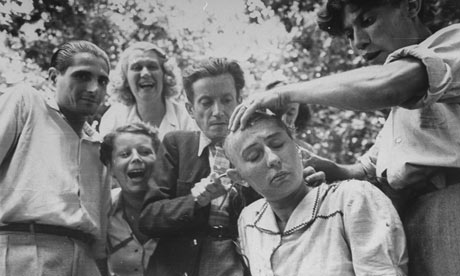
Perhaps most shocking is the way Marguerite was treated. While she herself actually helps the resistance, she is an obvious target, a visible 'traitor' as everyone has seen her with a German man. She is subjected to a public humiliation and head-shaving to forever mark her as a collaborator, a practice sadly common at a time when everyone was trying to prove their innocence by piling blame onto an easy target.


Musicals are too often dismissed as light and fluffy - and some of them most certainly are - but Marguerite is undoubtedly a musical for grown-ups. Beyond the wonderful music and story-telling that Boublil and Schönberg are famous for, Marguerite is a fascinating insight into a period that too many people would rather ignore.