Showing posts with label surrealism. Show all posts

Sunday, 27 January 2013

Reina Sofia: A trip through some of my favourite artworks

The Prado may be the most famous museum in Madrid, home to some of the greatest works in Spanish history by the likes of Goya and Velázquez, but I've now been to Madrid twice without stepping inside its doors. Instead, I'm always seduced by the Reina Sofia, home to key pieces from some of my favourite artistic movements. While my last visit was taken up with postwar art, especially Fluxus, (plus a room full of Dalí that I couldn't find anywhere this time), on my recent visit I finally made it to the centrepiece of the museum: Picasso's Guernica.


I've grown up with Guernica on the wall of my living room, but seeing it full size (11.5" x 25.5") still had an incredible impact on me. Picasso's 1937 protest against the fascist bombing attack which destroyed this civilian Basque tow confronts you the full terror and despair of the Spanish Civil War, and remains one of the most iconic pictures of all time. Reina Sofia adds to the original painting with preliminary sketches, photos of painting in progress and countless other anti-Franco/anti-Fascist works which put the piece in context. 

While many people apparently go straight to the Guernica and then head off to the Prado, it's a gallery where you really need time to study the pieces on display and learn about their history to really appreciate them. There is far too much in the galley to do this for everything, so I'd love to live in Madrid and take a room or two at a time until I'd seen the whole place properly. The Reina Sofia is like a walk through the European Avant-Garde class I took in second year - my favourite of all the courses I've ever taken - in which we explored Dada, Futurism and Surrealism. All of the key pieces from those movements are there, from the Lumière Brothers' hypnotising Serpentine Dance (1899) to Francis Picabia's Portrait of a Young American Girl in a State of Nudity (1915), exploring in very different ways the power of the machine in creating modern identities. I particularly loved seeing an original copy of Blaise Cendrars' poem The Prose of the Transiberian and the Little Jehanne de France beautifully illustrated by Sonia Delauny (enough copies were made so that if they stood end to end they would reach the top of the Eiffel Tower).


As well as the European Avant-Gardes, Reina Sofia is home to twentieth century Spanish greats: Mirò, Tapiès, Picasso (as we've seen above), Dalí, and lesser known artists like Juan Gris, all of whom prove the immense, unparalleled creativity emanating from Spain.

Picasso, The Painter and the Model, 1963
Joan Mirò, Woman and Dog In Front of the Moon, 1936
I'm looking forward to my next trip, when I can take more time to discover some new pieces.

Sunday, 29 April 2012

Surrealism and advertising

Hello again, blogosphere, I've missed you. The Cardiff culture blogging will resume shortly, but in the mean time, I thought I'd share something I love with you. Browsing just now, I came across Bibble Babble's (@sighnomoree) collection of the Best of Fast Food Advertising. I've always been a huge fan of clever adverts, especially those that show some knowledge of art history. My favourite of all are those inspired by surrealism.

Surrealism and advertising's love-affair is a long one. Surrealists, especially writers like André Breton and Louis Aragon, liked to incorporate real-life adverts into their work, for example this picture in Breton's Nadja: 


Beyond incorporating advertisements into their work, surrealists also profited from advertising, and no-one more so than Salvador Dalí. Breton famously remarked that 'Avida Dollars' (avida meaning eager or greedy for in Spanish) was a fitting anagram of Dalí's name. 

His advertising legacy lives on in the Chupa Chups logo, but perhaps my favourite example of Dalí's willingness to give up his integrity for advertising dollars is this TV spot for Lanvin chocolate:

Dalí wasn't alone, of course. If you go to any Spanish high-street, for example, you'll spot the logo for La Caixa bank, designed by Miró.

Beau comme la rencontre fortuite sur une table de dissection d'une machine à coudre et d'un parapluie: Surrealist concepts in modern advertising
Moving towards today, it's clear that advertising executives have studied their art history, especially those who worked in the tobacco market. Obviously I don't condone smoking, and especially not trying to make cigarettes attractive, but they did make some brilliant adverts.

In the 1970s Benson & Hedges campaign, for example, all the surrealist staples are present, from Dalí's ants to the guiding principle that bringing two incongruous things together will create something beautiful.


Other adverts also followed the surrealists in their obsession with and exploration of Eros and Thanatos (Freud's sex and death drives). Particularly striking is the 1980s Silk Cuts campaign.


This brings me to my favourite advert of all time (although the Compare the Meerkat series do come close ;) )  I remember seeing this on TV years and years ago, and it's stuck with me, even though it never seems to appear on Best Ever Adverts lists. I'm surprised it didn't give me nightmares! I love that it's so magnificently weird, referencing classic moments from Dalí and Buñuel's L'Age d'or and Un Chien Andalou, among other early surrealist films, from the eggs and the ants to the clouds cutting across the moon.


More recently, the 2007 Gorilla marketing (hehe, pun!) campaign that saved Cadbury's once again brought surrealist principles to the small screen. The gorilla on the drums was as unexpected and beautiful 'as the encounter between a sewing machine and an umbrella on an operating table'.


These are just a few examples of recent surrealist advertising, but I'd love to see more. Please comment with your favourites!

PS: I love how surrealist works are put on just about everything to make money. This is one of my favourites:
Ceci n'est pas un Powerbook.


Saturday, 24 December 2011

The Guerrilla Girls Get Me Thinking About Women in Art

When I told my mum recently that I thought I was becoming quite a feminist, she replied that I can’t be, because I have a boyfriend! While this is quite an extreme case, misconceptions about what feminism means are incredibly common (see Feminist Frequency's wonderful video on the trope of the straw feminist). In class recently we discussed how feminists certainly aren’t one hegemonic group and that feminism is more difficult to define than I had thought. Different groups of feminists have different agendas ranging from thinking gender differences should be celebrated to thinking they should be ignored with women and men treated equally. However, all feminists would agree that women should not be denied the same privileges as men just because of their gender.

And that’s where Guerrilla Girls come in. Guerrilla Girls highlight the gender disparities in the art world and fight to rectify them. They publish books, protest at museums and galleries and give talks about female artists and their subordination. I saw their posters for the first time in the Tate Modern the other day and was struck by the statistics they presented. Oddly, my friend and I had just been discussing how many female nudes there still are in modern art, compared to just one male nude that we had seen in the gallery (Barkley Hendricks’ 1974 Family Jules: NNN (No Naked Niggahs), portraying a naked Afro-American to challenge the fear of black male sexuality prevalent in the States at the time).


I hadn’t ever really thought before about whether the pictures on the postcards and in the books I buy are produced by men or women (I’m usually just sucked in by the pretty colours!), but I was disappointed with what I found. In my postcard collection there are just three paintings by women out of about 50. That’s slightly better than the museum average, but not great. They are:

Bridget Riley – Nataraja 1993


Lyubov Popova – Portrait 1914-15

Alexandra Exter – City at Night 1913

Interestingly two of the three are Russian. Was Russia more excepting of women artists in the early 20th century than other countries?

There are thirteen female nudes, mainly because I have a lot of Picasso cards (seven nudes) as well as one creature that is evidently a naked female from Miró, and five in Patrick Caulfield’s response to Picasso, Les Demoiselles d’Avignon vues de derrière (1999). 
As for males, there are just two, another Picasso, this time Seated man resting on elbow (after Manet’s Luncheon on the Grass) (1962) [I can't find this picture on the internet so will take a photograph and upload it once I'm reunited with my camera] and another disturbing Miró creature in the charmingly named Man and Woman in front of a pile of excrement (1935).


 I assume museum shops stock significantly less postcards of art by women, and more of female nudes, as (even allowing for my Picasso fixation) I can’t imagine I recreated the Guerrilla Girls’ statistics on purpose.

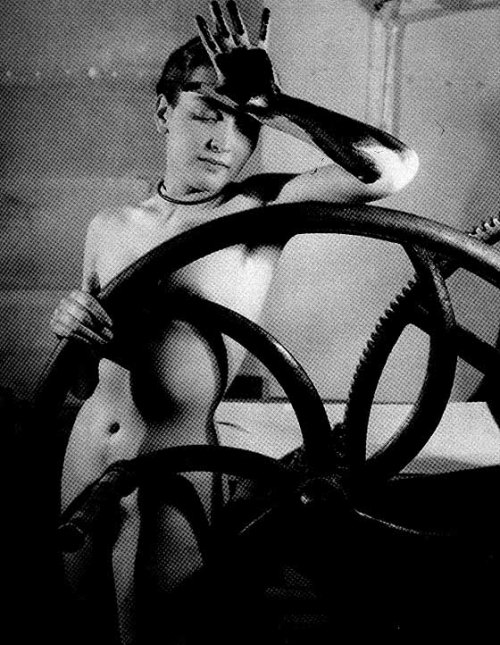
Man Ray's 1933 portrait of Oppenheim,
 in the role of muse rather than creator
As for books, my Taschen Surrealism, incidentally written and edited by women, is a particularly good/bad example. It has just two pages dedicated to Meret Oppenheim, stating that she was accepted by the Surrealists “largely because of a brief love affair with Max Ernst in 1934”. Given that Ernst was a serial womaniser, by that logic half the female artists in Europe should have become Surrealists! In fact David Hopkins notes that, as well as Oppenheim, “Leonora Carrington, Leonor Fini and Dorothea Tanning had romantic attachments to Max Ernst”. Yet she was one of the most innovative and influential creators of art using found objects, one of the Surrealist’s key aesthetic aims. She was also one of the few artists of the time who explored the possibility of female fetishism and erotic experiences, rather than just being the playthings of men. She deserves today to be more widely known and given more recognition in studies of Surrealism. But her contemporaries also deserved to be accepted by the Surrealists at the time and allowed to create works rather than just playing the muse. This is the double aim for which the Guerrilla Girls fight – for the recognition of women 
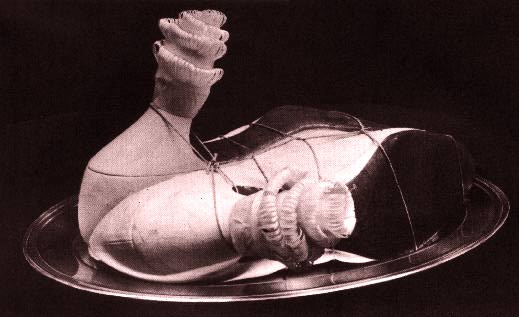
Oppenheim's My Nurse, 1936             
as artistic creators, against the subordination of women as artistic subjects.
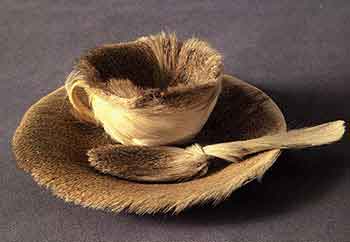
Fur Breakfast, 1936, Oppenheim's most famous piece


Feeling somewhat ashamed by the results of my postcard test, I need to research more female artists. Off the top of my head, apart from those mentioned above, I can only name recent headline grabbers like Tracy Emin, Sarah Lucas, Yoko Ono and Louise Bourgeois; Frida Kahlo, who's familiar to anyone learning Spanish; Georgia O’Keeffe; futurist Sonia Delauny (and that’s only from having studied futurism in depth); and my beloved Sophie Calle (more on her later). That’s more than I thought I had in my head when I started writing this but still ludicrously few. I will have to buy the Guerrilla Girls’ Bedside Companion to the History of Western Art and educate myself!


Wednesday, 14 December 2011

Chirinos, Dalí and Ants

I should really be asleep right now but when I turn out the lights and get into bed, my brain keeps whirring, telling me I can't get to sleep until I get to the bottom of the symbolism of ants. This probably sounds quite strange, but I've recently finished the quite exceptional El niño malo cuenta hasta cien y se retira by Juan Carlos Chirinos (which you will hear a lot about if you follow this blog as I hope to feature it in my future academic research) and one of the many things that struck me about it were the ants.


As a very short introduction (a more in depth one will come soon, possibly in the form of podcast), the story revolves around D.Jota who leaves Caracas for a journey to an exotic North. There he ends up staying with a young shepherdess named Fanny and her grandmother, near El Pueblo, where Svevo is the resident story teller. Ants figure prominently in two of his stories:

  • In the first, a woodcutter is about to chop down a tree when an ant appears from inside it and asks him not to, as it is home to the ants who provide food for the humans. They agree that the ants will vacate a tree each time he needs one and that way everyone is happy. It works out well until one day the woodcutter follows the ant to an enormous tree full of food. Overwhelmed by greed, the woodcutter chops down the tree and food rains on the village. The ant chastises the woodcutter for his ignorance, as the tree was the source of the food the ants brought to the villagers and now they have nothing left to bring them. Yet the ant sticks to his word and continues vacating trees to provide wood. One day the woodcutter finds out he is having a baby and goes to tell the ant the good news; the ant replies by giving the child it's name, Derdriu, which is the name of the grandmother.
  • In the second story, Svevo explains how Fanny's dog is the grandson of a dog that her grandfather Eugenio rescued from a giant ant in the middle of the forest.
Back in the present, D.Jota observes the ants storming his picnic and compares them to those back in Caracas.

Being a big fan of surrealism, I couldn't read these passages without thinking of Dalí, who made frequent use of ants in his work. I remember reading about a letter Dalí sent to Buñuel detailing the exact type of ants he wanted for Un Chien Andalou and how he imported them from Spain because the right type weren't to be found in France.

Chirinos is certainly aware of the surrealists' activities, as in one particularly touching scene D.Jota plays Exquisite Cadavers with his best friend (and more) Madaín. In this context, it's hard not to assume a link between the two, but what is the deeper symbolism?

I started googling psychoanalysis and ants, hoping Freud would have written a wonderful treatise about it somewhere. He didn't. I did however find various other mentions of ants in dream analysis. Most of them talk about ants as industrious, hard-working and patient creatures, stating that if you dream about ants you're likely to be productive the next day. That doesn't really seem to fit with either Chirinos' novel or Dalí's work. More interesting is the idea that ants symbolise death and decay, which certainly fits with the darker themes of El niño malo... I see them almost as a warning, creating a sense of foreboding, preparing the reader for the dark times ahead. I'd be very interested to know Chirinos' opinion on it though!