When I told my mum recently that I thought I was becoming
quite a feminist, she replied that I can’t be, because I have a boyfriend!
While this is quite an extreme case, misconceptions about what feminism means
are incredibly common (see Feminist Frequency's wonderful video on the trope of the straw feminist).
In class recently we discussed how feminists certainly aren’t one hegemonic
group and that feminism is more difficult to define than I had thought. Different
groups of feminists have different agendas ranging from thinking gender differences should be celebrated to thinking they should be
ignored with women and men treated equally. However, all feminists
would agree that women should not be denied the same privileges as men just
because of their gender.
And that’s where
Guerrilla Girls come in. Guerrilla
Girls highlight the gender disparities in the art world and fight to rectify
them. They publish books, protest at museums and galleries and give talks about
female artists and their subordination. I saw their posters for the first time
in the Tate Modern the other day and was struck by the statistics they
presented. Oddly, my friend and I had just been discussing how many female nudes
there still are in modern art, compared to just one male nude that we had seen in the
gallery (Barkley Hendricks’ 1974
Family Jules: NNN (No Naked Niggahs),
portraying a naked Afro-American to challenge the fear of black male sexuality
prevalent in the States at the time).

I hadn’t ever really thought before about whether the
pictures on the postcards and in the books I buy are produced by men or women
(I’m usually just sucked in by the pretty colours!), but I was disappointed
with what I found. In my postcard collection there are just three paintings by
women out of about 50. That’s slightly better than the museum average, but not
great. They are:
Bridget Riley – Nataraja 1993
Lyubov Popova – Portrait 1914-15
Alexandra Exter – City at Night 1913
Interestingly two of the three are Russian. Was Russia more
excepting of women artists in the early 20th century than other
countries?
There are thirteen female nudes, mainly because I have a lot
of Picasso cards (seven nudes) as well as one creature that is evidently a naked
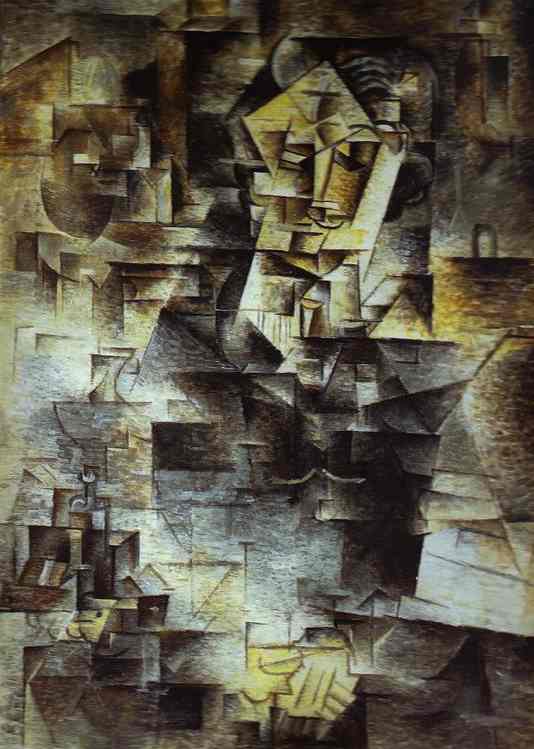
female from Miró, and five in Patrick Caulfield’s response to Picasso, Les Demoiselles d’Avignon vues de derrière (1999).
As for males, there are just two, another Picasso, this time
Seated man resting on elbow (after Manet’s
Luncheon on the Grass) (1962) [I can't find this picture on the internet so will take a photograph and upload it once I'm reunited with my camera] and another disturbing Miró creature in the
charmingly named
Man and Woman in front of
a pile of excrement (1935).
I assume museum shops stock significantly less
postcards of art by women, and more of female nudes, as (even allowing for my
Picasso fixation) I can’t imagine I recreated the Guerrilla Girls’ statistics on purpose.
 |
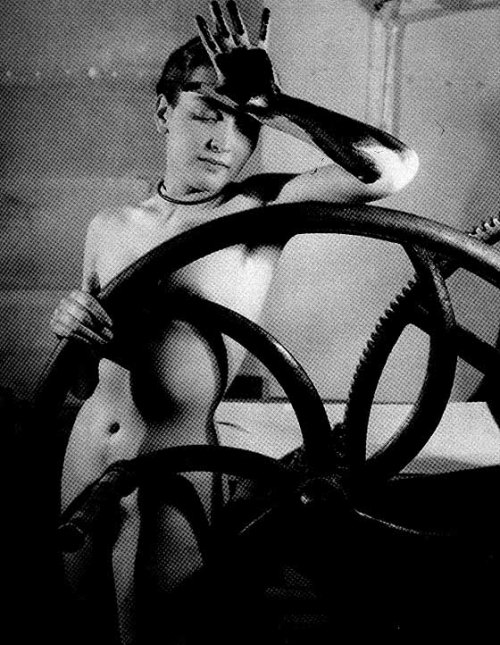
Man Ray's 1933 portrait of Oppenheim,
in the role of muse rather than creator |
As for books, my Taschen Surrealism,
incidentally written and edited by women, is a particularly good/bad example.
It has just two pages dedicated to Meret Oppenheim, stating that she was
accepted by the Surrealists “largely because of a brief love affair with Max
Ernst in 1934”. Given that Ernst was a serial womaniser, by that logic half the
female artists in Europe should have become Surrealists! In fact David Hopkins
notes that, as well as Oppenheim, “Leonora Carrington, Leonor Fini and Dorothea
Tanning had romantic attachments to Max Ernst”. Yet she was one of the most
innovative and influential creators of art using found objects, one of the
Surrealist’s key aesthetic aims. She was also one of the few artists of the
time who explored the possibility of female fetishism and erotic experiences,
rather than just being the playthings of men. She deserves today to be more
widely known and given more recognition in studies of Surrealism. But her
contemporaries also deserved to be accepted by the Surrealists at the time and
allowed to create works rather than just playing the muse. This is the double
aim for which the Guerrilla Girls fight – for the recognition of women
 |
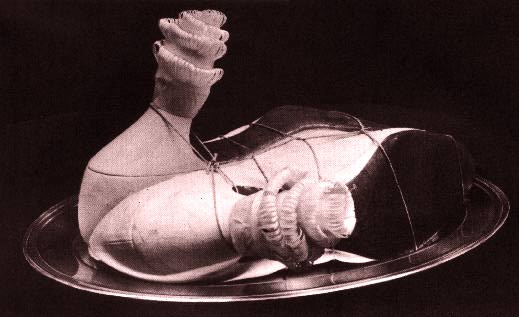
| Oppenheim's My Nurse, 1936 |
as
artistic creators, against the subordination of women as artistic subjects.
 |
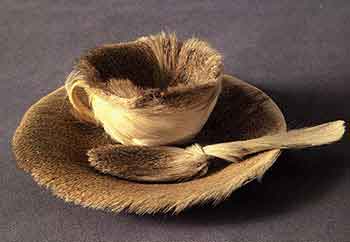
| Fur Breakfast, 1936, Oppenheim's most famous piece |
Feeling somewhat ashamed by the results of my postcard test,
I need to research more female artists. Off the top of my head, apart from
those mentioned above, I can only name recent headline grabbers like Tracy
Emin, Sarah Lucas, Yoko Ono and Louise Bourgeois; Frida Kahlo, who's familiar to anyone learning Spanish; Georgia O’Keeffe; futurist Sonia
Delauny (and that’s only from having studied futurism in depth); and my beloved
Sophie Calle (more on her later). That’s more than I thought I had in my head
when I started writing this but still ludicrously few. I will have to buy the
Guerrilla Girls’ Bedside Companion to the History of Western Art and educate
myself!